ZWO Seestar S30 Pro Review (2026): Is It Worth It?
This article contains affiliate links. If you buy through them, ORIVON may earn a commission at no extra cost to you.
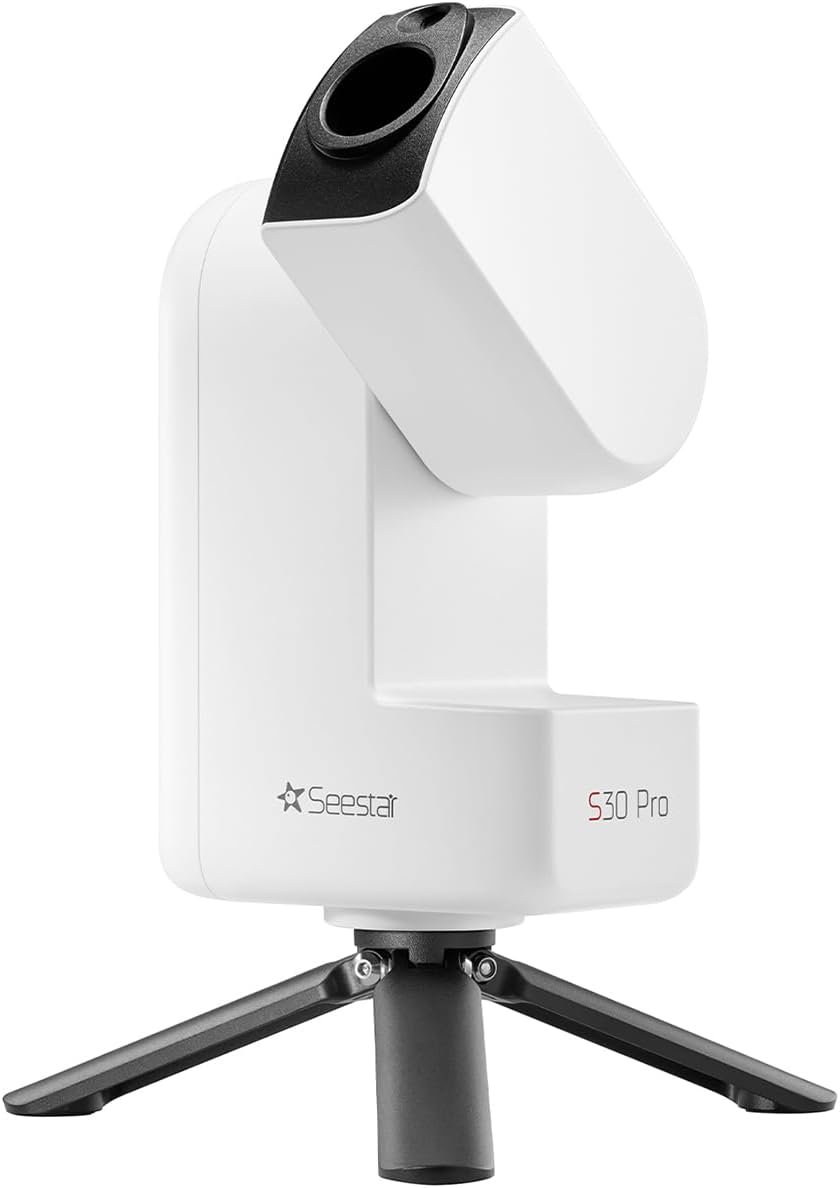
Credit: ZWO
The Seestar S30 Pro promises a portable, automated way into astrophotography — point your phone at it, tap a target, and let the app handle alignment, focus and stacking. That part of the pitch is real. What's less obvious from ZWO's marketing is where it actually sits in the smart telescope lineup: at $699, it's currently priced above both ZWO's own entry-level Seestar S30 and the larger-aperture Seestar S50, not below them. Whether that's worth paying depends on whether you value resolution, wide-field flexibility and automation more than raw aperture and eyepiece observation — not on which model happens to be cheapest.
Review Methodology
This review is an independent editorial analysis built from ZWO's official specifications and documentation, professional hands-on reviews, published sample images and recurring owner feedback. The goal is to gather, verify and compare the evidence that already exists — from ZWO's own manual to multiple outlets that have actually put the telescope under the sky — so a buyer can make an informed decision without cross-referencing six browser tabs themselves. Where sources disagree or a spec isn't firmly confirmed, we've said so rather than guessing at a precise number.
Price and availability checked August 5, 2026. Retail pricing and bundles may change.
Quick Verdict
Best for: beginners and portable-imaging fans who want an automated, dual-camera system for nebulae, clusters, the Moon, wide starfields and mosaics.
Avoid if: you want eyepiece observation, serious planetary detail, maximum light-gathering per dollar, or a system you can upgrade piece by piece.
Official price checked: $699 USD (ZWO US store, August 5, 2026).
Main strength: a genuinely upgraded 4K dual-camera system and one of the most automated setup experiences in this category.
Main limitation: a 30mm aperture that caps deep-sky and planetary detail, at a price above ZWO's own S30 and S50.
The S30 Pro makes sense for beginners and portability-focused buyers who want an automated astrophotography experience — especially for extended nebulae, clusters, the Moon, mosaics and wide-field shots. It's a weaker fit for anyone who wants to look through an eyepiece, chase planetary detail, maximize aperture per dollar, or build a system they can upgrade piece by piece over time.
Pros and Cons
What Reviewers Praise
- Compact, integrated design at 1.65kg — genuinely easy to pack and carry
- Automated app workflow: point, tap, and the system aligns, focuses and stacks on its own
- Upgraded 4K sensors on both the telephoto and wide-angle cameras
- FITS export alongside JPG, for buyers who want to process outside the app
- Mosaic support and a Plan Mode for scheduling multi-target sessions
- Three built-in filters, including a dual-band filter that helps against light pollution
- Optional EQ mode for longer, rotation-free exposures
- Genuinely fast for beginners — reviewers report usable results within minutes
- Handles night sky, Moon, filtered Sun and daytime/terrestrial use in one body
Common Criticisms
- No eyepiece — every session happens through the phone app, with no direct look-through option
- 30mm aperture, the limiting factor for faint deep-sky detail and planetary imaging
- Weak planetary performance specifically — reviewers describe it as the model's clearest weak point
- EQ mode needs a separate wedge accessory and a polar alignment step, not a built-in native mount
- Priced above ZWO's own S30 and S50, so it isn't the budget pick in its own lineup
- Real-world battery life runs shorter than the ~6-hour spec in cold weather
- At least one detailed test reported a 60-second maximum single exposure and a USB port that loosened after months of use
- No simultaneous dual-camera live view — the app has you choose one feed or the other during imaging
What the Seestar S30 Pro Actually Is
"Smart telescope" is a slightly misleading label if you're picturing a traditional telescope with a screen bolted on. The S30 Pro is closer to a purpose-built imaging appliance: a small apochromatic optical tube, a dedicated astronomy camera, a second wide-angle camera, a motorized alt-azimuth mount, an electronic focuser, a filter wheel, a battery, onboard processing, and a phone app that ties all of it together. There's no eyepiece anywhere in that chain — you never look through the instrument directly. Everything you see is a live, processed feed on a screen, built from stacked exposures the telescope captures and combines automatically.
Specifications
| Spec | Value |
|---|---|
| Telephoto aperture | 30mm |
| Telephoto focal length / ratio | 160mm / f/5.3 |
| Telephoto field of view | 4.6° |
| Telephoto sensor | Sony IMX585 |
| Wide-angle focal length / ratio | 6mm / f/1.75 |
| Wide-angle field of view | 63° |
| Wide-angle sensor | Sony IMX586 |
| Resolution (both cameras) | 3840 × 2160 (approx. 8.3MP) |
| Optical design | 4-element apochromatic, ED glass (telephoto) |
| Filters | UV/IR cut, dual-band (light pollution), dark field |
| Mount | Alt-azimuth, with optional EQ mode (wedge accessory required) |
| Storage | 128GB internal |
| Image / video formats | JPG, FITS / MP4, AVI |
| Battery | 6000mAh, rated up to ~6 hours under specific conditions |
| Connectivity | Wi-Fi, NFC, USB-C, Bluetooth |
| Weight (body, no tripod) | 1.65kg |
| Dimensions | 210 × 140 × 80mm |
Weight is the body without the tripod. Specifications sourced from ZWO's official product pages; confirm against the current listing before buying, since firmware and software features can change.
Design, Portability and Setup
At 1.65kg for the body alone, the S30 Pro fits in a daypack alongside a jacket and a water bottle — a genuinely different proposition from a traditional telescope that needs its own case and a car trip. Setup, per multiple hands-on accounts, is built around near-field communication: power the unit on, tap a compatible phone to it, and the app connects without manually hunting for a Wi-Fi network. From there it's a matter of leveling the tripod, letting the app run its alignment routine, and selecting a target.
The instrument depends entirely on a phone or tablet — there's no standalone display or control. What ships in the box can vary by region and bundle (tripod quality, any included wedge or filter, charging cable), so confirm the exact contents of your specific SKU on ZWO's store before assuming a part is included.
App and Automated Workflow
The typical session, based on how reviewers describe it: power on, connect via NFC or Wi-Fi, let the app initialize and plate-solve its position, pick a target from the Sky Atlas, and tap Go. The mount slews to the target, autofocuses, and begins live stacking — building up a cleaner image over time as more exposures accumulate, visible in near real time on the screen. Plan Mode extends this to a full night's shot list, queuing multiple targets so the session can run with less manual intervention.
Processing happens inside the app by default, and reviewers describe the results as solid for casual sharing. For anyone who wants to push further, FITS export lets the raw stacked data move into dedicated software like DeepSkyStacker or Astro Pixel Processor, which at least one reviewer found produced meaningfully better results on faint nebulae than the in-app pipeline alone. The trade-off for all this automation is that you're working inside ZWO's software ecosystem — one reviewer's specific criticism was the inability to view both cameras' feeds simultaneously during an imaging run, forcing a choice between deep-sky framing and situational awareness of the wider sky.
Image Quality
Nebulae
This is where the wide 4.6° field of view earns its keep — several reviewers note it's large enough to frame the Orion Nebula or the North America Nebula without stitching a mosaic, something smaller-field competitors can't do. The built-in dual-band filter is specifically aimed at emission nebulae, isolating their narrow wavelengths from broader light pollution. Sample results shown in reviews are genuinely good for the price and category, but they represent a curated best case, not a guaranteed outcome for every sky and every session.
Galaxies
Large, bright galaxies are within reach — reviewers have captured Andromeda with real structure visible after around 44 minutes of accumulated exposure. Smaller, fainter galaxies are a tougher target: with only 30mm of aperture and a 160mm focal length, the S30 Pro gathers far less light and resolves far less fine structure than telescopes with 50mm or more of aperture, which is exactly the trade-off you're making for the compact form factor.
Star Clusters
Open clusters, which are typically brighter and more spread out, are a comfortable match for the wide field. Small, dense globular clusters ask more of the optics — resolving individual stars near a globular's core benefits from more aperture and focal length than this telescope has on tap.
Moon and Sun
The Moon is a strong, forgiving target for a telescope like this — bright, high-contrast, and well within the resolution the sensors can deliver. Solar imaging is possible, but only with the correct solar filter properly installed and only by following ZWO's manual exactly; the built-in dark-field, UV/IR-cut and dual-band filters are for nighttime imaging and are not a substitute for dedicated solar protection. If you're planning to photograph the Sun with this or any instrument, read ORIVON's eclipse and solar safety guide first.
Planets
Here the limitations are clearest. Reviewers who pointed the S30 Pro at Jupiter came away with a recognizable but small disc, without the moon-by-moon or cloud-band detail a longer-focal-length, planetary-oriented setup can show. Digital zoom doesn't meaningfully change that — it enlarges the same limited data rather than adding resolution. If planetary imaging is your priority, this specific instrument isn't built for it, and no smart telescope in this compact-aperture category will substitute for a dedicated long-focal-length system.
Milky Way, Star Trails and Wide-Angle
The second camera is where the S30 Pro earns its "dual" branding beyond marketing language. At 6mm and f/1.75 with a 63° field, it's built for the wide shots the telephoto camera can't take: Milky Way panoramas, star trail sequences, and nightscapes with real foreground. One reviewer specifically praised its ability to stitch an 84° Milky Way panorama in a single automated capture. It's a genuinely different, complementary tool from the deep-sky camera, not a marketing footnote.
Performance Under City Skies
The dual-band filter is a real, tested advantage for emission nebulae from light-polluted skies — one detailed review reported usable nebula signal from a Bortle 7–9 urban location, helped along by the live-stacking approach building up data over an extended session. That advantage narrows for broadband targets: galaxies, open clusters and reflection nebulae don't benefit from a narrowband filter the same way, and still look better from a genuinely dark site. Moonlight, humidity, sky transparency and local light sources all still matter regardless of what filter is installed — a dark sky remains an advantage this telescope can't fully engineer around.
Alt-Azimuth vs. EQ Mode
By default, the S30 Pro operates alt-azimuth — the simpler configuration, but one that introduces field rotation over longer exposure sequences, which limits how long any single stacked image can effectively run before stars start to smear at the frame's edges. EQ mode addresses that by aligning the mount's rotation with the sky's own motion, but it is not a native equatorial mount: ZWO's own materials and independent reviewers agree it requires a compatible wedge accessory, plus a polar alignment step, to function. That's more setup complexity and one more thing to buy — not a feature that's simply "on" out of the box. Plenty of buyers, especially first-time users, get real value from the telescope without ever touching EQ mode.
Battery, Storage and Connectivity
ZWO's 6000mAh battery is rated for "up to approximately six hours" under specific conditions the company defines — treat that as a best-case ceiling, not a guarantee. Independent testing found roughly five to six hours in mild temperatures, dropping meaningfully in cold weather, which tracks with how lithium batteries generally behave outdoors. Running anti-dew heaters, Wi-Fi and active tracking simultaneously will also draw down a session faster than an idle unit. The 128GB of internal storage is double the standard S30's 64GB, giving more headroom before you need to offload files over Wi-Fi or USB-C. NFC handles the initial pairing handshake; Bluetooth and Wi-Fi carry the ongoing connection to the app.
Seestar S30 Pro vs. S30 vs. S50 Pro
Update, August 27, 2026: The original Seestar S50 referenced when this review was first published has since been reported discontinued by ZWO (production ended, per independent reporting citing a ZWO executive, in April 2026). ZWO's current 50mm-class model is the new Seestar S50 Pro, launched for preorder in August 2026. The comparison below reflects ZWO's current lineup.
| Model | Price (official) | Aperture | Sensor(s) | Weight | Storage |
|---|---|---|---|---|---|
| Seestar S30 | $399 | 30mm | Sony IMX662 (single camera) | 1.65kg | 64GB |
| Seestar S30 Pro | $699 | 30mm (+6mm wide-angle) | Sony IMX585 + IMX586 (dual camera) | 1.65kg | 128GB |
| Seestar S50 Pro | $899 launch / $999 regular | 50mm (+6mm wide-angle) | 8.3MP dual camera (sensor models undisclosed) | 2.8kg | 128GB eMMC |
Prices as listed on each model's official ZWO store page, checked August 27, 2026.
The S30 is ZWO's true budget entry point: same compact body and aperture as the Pro, but an older single-camera sensor and half the storage, at the lowest price of the three. The S50 Pro trades the S30 Pro's portability for genuinely more aperture and focal length — more raw light-gathering for deep-sky targets — in a heavier package, while matching its dual-camera, high-resolution sensor architecture. The S30 Pro sits between the two on price and remains the lighter, more travel-friendly option; it competes on portability and resolution-per-gram rather than raw aperture. For the complete breakdown, see ORIVON's dedicated Seestar S50 Pro vs. S30 Pro comparison and S50 Pro first look.
Is the Seestar S30 Pro Worth $699?
As a self-contained system, the case for the S30 Pro is genuinely strong: an automated, phone-controlled workflow, two useful cameras instead of one, 4K sensors, FITS export for anyone who wants to process further, and a form factor that fits in a bag rather than a car trunk. Reviewers consistently rate the ease-of-use and automation highly, and the images shared from real sessions — not just marketing renders — back that up for its intended targets.
Where the value case weakens is against ZWO's own lineup: at $699, it costs $300 more than the standard S30 for a better sensor pair and double the storage, and $150 more than the S50's listed $549 for less raw aperture, trading that light-gathering for resolution and a second wide-angle camera instead. Whether that trade is worth it depends entirely on what you're optimizing for — it's a poor deal if aperture-per-dollar is your only metric, and a reasonable one if you specifically want the wide-field camera, the higher resolution, or EQ mode support. Compared to assembling an equivalent traditional setup — a mount, an optical tube, a dedicated astro camera and guiding gear bought separately — the S30 Pro is simpler and often cheaper up front, but far less flexible: you can't swap its optics, upgrade its sensor, or repurpose its mount the way you can with a modular traditional rig.
Who Should Buy It?
- Beginners who want to get into astrophotography without a steep technical learning curve
- Urban imagers who want automation plus a light-pollution filter tuned for emission nebulae
- Travelers who want a genuinely packable imaging setup
- Anyone who specifically wants to shoot large, wide targets — extended nebulae, Milky Way panoramas, star trails
- Existing visual-telescope owners who want a separate, automated second instrument just for imaging
- Buyers who want FITS export as an option, even if they start with in-app processing
Who Should Skip It?
- Anyone who wants to look through an eyepiece — this and every smart telescope on ORIVON has none
- Buyers primarily interested in planetary detail
- Anyone prioritizing maximum aperture and light-gathering per dollar
- Users who don't want to depend on a phone app for every session
- Astrophotographers who want a modular system they can upgrade piece by piece
- Current S50 owners expecting the S30 Pro to be a straightforward, universal upgrade — it trades aperture for resolution and portability, not a strict improvement in every respect
Accessories Actually Worth Considering
- A compatible EQ wedge — only if you specifically want longer, rotation-free exposures; skip it if you're happy shooting alt-az.
- A sturdier tripod — worth considering if your bundle's included tripod feels short or unstable in the spots you actually shoot from.
- A USB-C power bank — extends a session well past the roughly six-hour internal battery figure.
- A padded case — reasonable insurance for a telescope you're specifically buying to travel with.
- A phone or tablet with reliable Wi-Fi and Bluetooth — the whole experience runs through it, so an older or flaky device can bottleneck the workflow.
None of these are strictly required to use the telescope — treat this as optional, not a shopping list.
Final Verdict
Yes, the Seestar S30 Pro is worth $699 — for the right buyer. That buyer is a beginner or portability-focused imager who wants an automated, dual-camera system for nebulae, clusters, the Moon, mosaics and wide starfields, and who's comfortable trading eyepiece observation and maximum aperture for convenience. Its biggest strength is how much of the technical difficulty of astrophotography it automates away, backed by a genuinely upgraded sensor pair over the standard S30. Its biggest weakness is the same one every 30mm smart telescope has: limited light-gathering that shows up hardest on faint deep-sky targets and on planets specifically — and, unlike the S50 it's often compared against, it doesn't win on aperture. Buy it for what it actually is, not for a "biggest upgrade" story ZWO's marketing doesn't quite support.
Frequently Asked Questions
For a buyer who wants an automated, portable, dual-camera imaging system and values ease of use over raw aperture, most hands-on reviewers say yes. It's a harder sell for anyone chasing the largest possible aperture per dollar, since it's currently priced above ZWO's own S30 and S50.
Yes — reviewers consistently describe the setup and app workflow as one of its strongest points, with usable results reachable within minutes of first use, no polar alignment required in standard mode.
No. Like every smart telescope ORIVON covers, it has no eyepiece — all framing, focusing and imaging happen through the Seestar app on a phone or tablet.
Not particularly. Multiple hands-on reviewers single out planetary imaging as its weakest area — its 160mm focal length and 30mm aperture produce a small planetary disc with limited surface detail, even with digital zoom.
Its built-in dual-band filter noticeably helps with emission nebulae from bright urban skies, according to at least one detailed hands-on test from a Bortle 7–9 location. It does less for broadband targets like galaxies and star clusters, where a genuinely dark sky still matters.
Yes, as an optional mode alongside its default alt-azimuth operation. It is not a traditional native equatorial mount.
Yes. ZWO's own documentation and independent reviewers agree that EQ mode needs a compatible wedge accessory and a polar alignment step — it isn't ready to use out of the box.
Yes, alongside JPG for images and MP4/AVI for video, which lets more advanced users take frames into external stacking and processing software instead of relying solely on the in-app pipeline.
The S30 Pro and standard S30 share the same 30mm optical design and similar weight, but the Pro adds a higher-resolution sensor pair, doubled internal storage and EQ mode support, at a higher price. The original S50 has since been reported discontinued by ZWO (April 2026); its 50mm-aperture role in the current lineup is now filled by the new Seestar S50 Pro, which pairs that larger aperture with the same dual-camera architecture as the S30 Pro.
ZWO's documentation describes an external magnetic solar filter accessory for the Seestar line; confirm exactly what's included with your specific bundle before assuming solar filming is ready out of the box, and always follow the manual's solar safety instructions.
ZWO rates it at approximately six hours under specific conditions. Independent testing reports roughly five to six hours in mild weather and noticeably less in cold temperatures, so treat six hours as a best-case figure, not a guarantee.