Celestron Origin Mark II vs. ZWO Seestar S30 Pro: Which Smart Telescope Should You Choose?
This article contains affiliate links. If you buy through them, ORIVON may earn a commission at no extra cost to you.
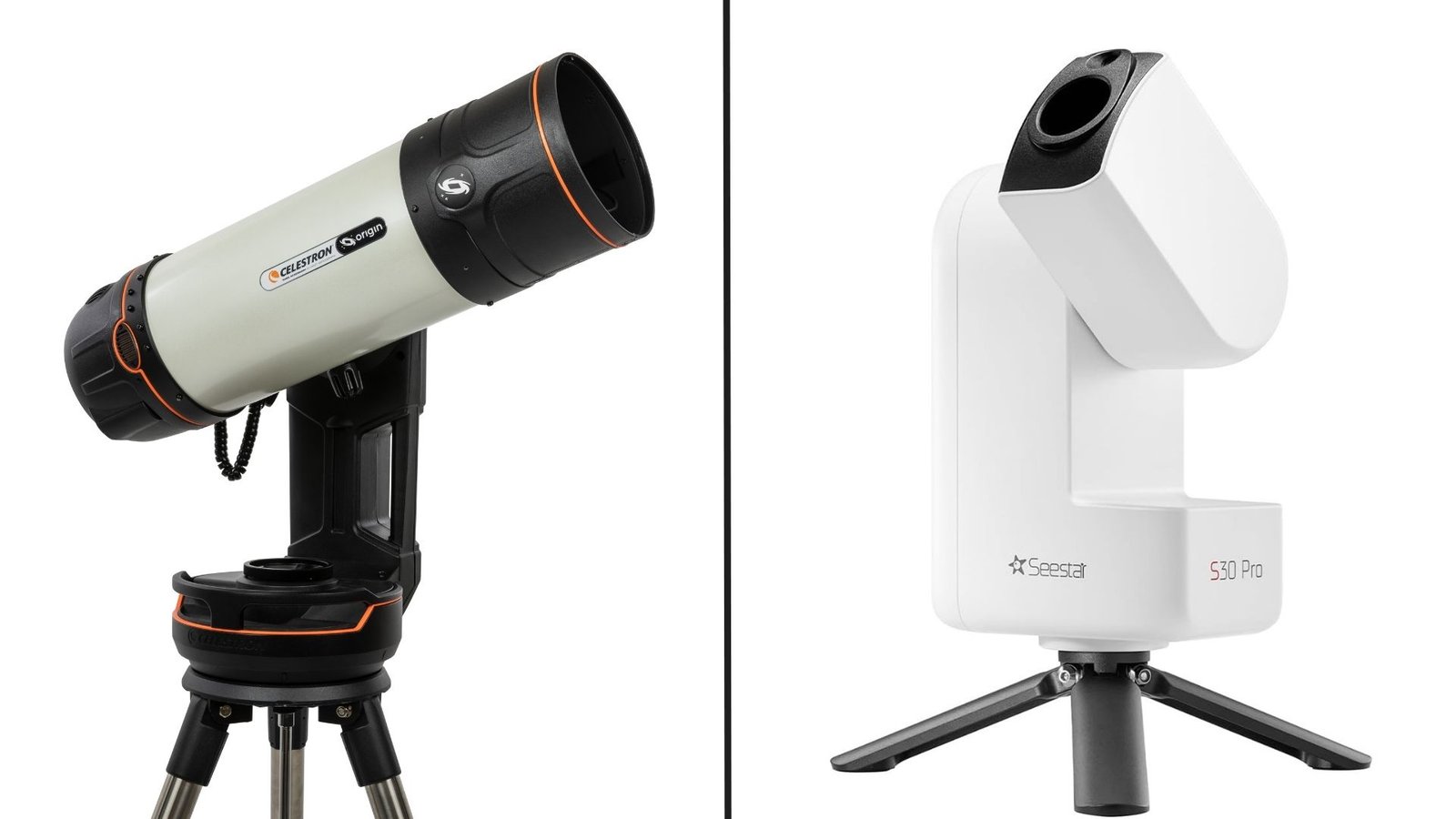
Credit: Celestron (Origin Mark II) / ZWO (Seestar S30 Pro)
Two Smart Telescopes at Opposite Ends of the Market
The Celestron Origin Mark II and the ZWO Seestar S30 Pro rarely get cross-shopped by accident — one costs roughly six times the other. But readers ask about this exact pairing constantly, usually while trying to figure out whether the Origin Mark II's price is actually justified, or whether a Seestar S30 Pro covers what they need for a fraction of the cost. This comparison is built for that question, not for pretending the two compete on equal footing.
A note on how this comparison was researched: ORIVON has covered both telescopes in dedicated pieces — our full Celestron Origin Mark II review and our full ZWO Seestar S30 Pro review — which go deeper on each unit individually. This comparison draws on that same research plus each manufacturer's published specifications, cross-referenced side by side to answer the question readers actually ask.
Technical Specifications
| Celestron Origin Mark II | |
| Aperture | 152mm (6") |
| Optical Design | Rowe-Ackermann Schmidt Astrograph (RASA) |
| Focal Ratio | f/2.2 |
| Focal Length | 335mm |
| Sensor | Sony 678C, STARVIS 2 CMOS |
| Field of View | Approximately 1.3° × 0.7° (calculated from focal length and sensor size; not an officially published figure) |
| Weight | Approximately 41.6 lbs (18.6 kg) fully assembled |
| EQ Mode | Optional wedge accessory required — not native, not included |
| Price | Approximately $4,299 USD |
| ZWO Seestar S30 Pro | |
| Aperture | 30mm (telephoto lens) |
| Optical Design | 4-element apochromatic refractor, dual-lens (telephoto + wide-angle) |
| Focal Ratio | f/5.3 |
| Focal Length | 160mm (telephoto) |
| Sensor | Sony IMX585, 8.3MP |
| Field of View | 4.6° (telephoto camera) / 63° (secondary wide-angle camera) |
| Weight | Approximately 3.6 lbs (1.65 kg) |
| EQ Mode | Optional wedge/tripod head accessory required — not native, not included |
| Price | Approximately $699 USD |
| Spec | Origin Mark II | Seestar S30 Pro |
|---|---|---|
| Aperture | 152mm | 30mm |
| Focal Ratio | f/2.2 | f/5.3 |
| Field of View | ~1.3° × 0.7° | 4.6° tele / 63° wide |
| Weight | ~18.6 kg (41.6 lbs) | ~1.65 kg (3.6 lbs) |
| EQ Mode | Optional accessory only | Optional accessory only |
| Price | ~$4,299 | ~$699 |
A note on pricing: smart telescope pricing moves. The Seestar S30 Pro's MSRP has changed at least once since launch; the figure above reflects its current listed price, not an introductory one. Always confirm current pricing at checkout before buying either telescope.
Optics & Deep-Sky Image Quality
This is the least ambiguous part of the comparison. The Origin Mark II's 152mm aperture is roughly five times the Seestar S30 Pro's 30mm, and its f/2.2 optical system is meaningfully faster than the S30 Pro's f/5.3. Between a much larger light-collecting surface and a faster focal ratio, the Origin gathers dramatically more light per unit of exposure time — which matters most on small, faint targets: planetary nebulae, distant galaxies, anything that needs real aperture to resolve detail rather than just register as a smudge (see how aperture affects what a telescope can reveal for why this matters more than any single spec number). The Seestar S30 Pro isn't built to compete on that axis, and by most accounts it doesn't try to.
Field of View & Wide-Field Imaging
The Seestar S30 Pro's advantage shows up here instead. Its telephoto camera covers about 4.6° of sky — already wider than the Origin's tighter, deep-sky-optimized frame — but its secondary wide-angle camera covers roughly 63°, letting it frame entire constellations or wide star fields the Origin's single optical tube simply can't capture in one shot. If what you actually want to photograph is a broad swath of the Milky Way rather than a tightly cropped nebula, the S30 Pro's dual-camera setup is doing something the Origin isn't built for at all.
Weight & Portability
At roughly 18.6kg fully assembled, the Origin Mark II is not a grab-and-go instrument — it ships as separate components (optical tube, mount, tripod) that go together before a session, and it's the kind of telescope that lives in a dedicated spot rather than getting thrown in a car on a whim. The Seestar S30 Pro, at about 1.65kg as a single integrated unit, is built for the opposite use case: pack it in a bag, set it up in minutes, and go somewhere darker without planning an expedition around it.
Setup Curve
Both telescopes are automated, app-guided smart telescopes, and both are praised in reviews for fast, low-friction setup relative to a traditional manually-aligned rig. The practical difference is more about physical logistics than software: the Origin's multi-piece assembly takes longer to get from car trunk to first light than the Seestar's single-unit design, even though neither requires the manual polar alignment and focusing routine a traditional telescope does.
EQ Mode, Confirmed
Neither telescope ships with native equatorial tracking — this is true of both, not just the Seestar. Both are alt-azimuth mounts by default, and both manufacturers have since added optional equatorial wedge support: Celestron's Origin wedge, and ZWO's TH10 Fluid Tripod Head for the Seestar line. In both cases, EQ mode is an added accessory and a software feature layered onto an alt-az mount, not a built-in equatorial mount in the traditional sense. If EQ tracking specifically is a requirement for you, budget for the extra hardware on either telescope — it isn't included with either one.
Who Each One Is For
The Origin Mark II makes sense for someone who cares most about deep-sky image quality on small, faint targets, and who has the budget and the dedicated space that a ~$4,299, 18-plus-kilogram instrument requires. It's a telescope you commit to, not one you casually bring along. The Seestar S30 Pro is the better fit for someone prioritizing portability, wide-field framing, and a genuinely accessible price — a first serious smart telescope, a travel companion, or simply a lower-stakes way into astrophotography before deciding whether to spend Origin Mark II money on the hobby at all.
Frequently Asked Questions
No. Out of the box, it's an alt-azimuth mount. ZWO added EQ mode as a software feature, but using it requires an additional wedge accessory, such as the TH10 Fluid Tripod Head — it isn't included and isn't native equatorial tracking in the traditional sense.
It's also alt-azimuth by default. Celestron later added equatorial wedge support, but it requires a separate accessory wedge, the same way the Seestar S30 Pro does. Neither telescope ships with native equatorial tracking.
The Origin Mark II, by a wide margin. Its 152mm aperture and f/2.2 optical system gather dramatically more light than the Seestar S30 Pro's 30mm optics, which matters most on small, faint targets like planetary nebulae and distant galaxies.
The Seestar S30 Pro. Its secondary wide-angle camera covers roughly 63° of sky, and at about 1.65kg it's a fraction of the Origin Mark II's assembled weight — a much easier telescope to grab and take somewhere.
No — this comparison is built from each manufacturer's published specifications and independent reviews of both telescopes, compared side by side rather than tested directly by ORIVON.