
Why Aperture Matters More Than Magnification
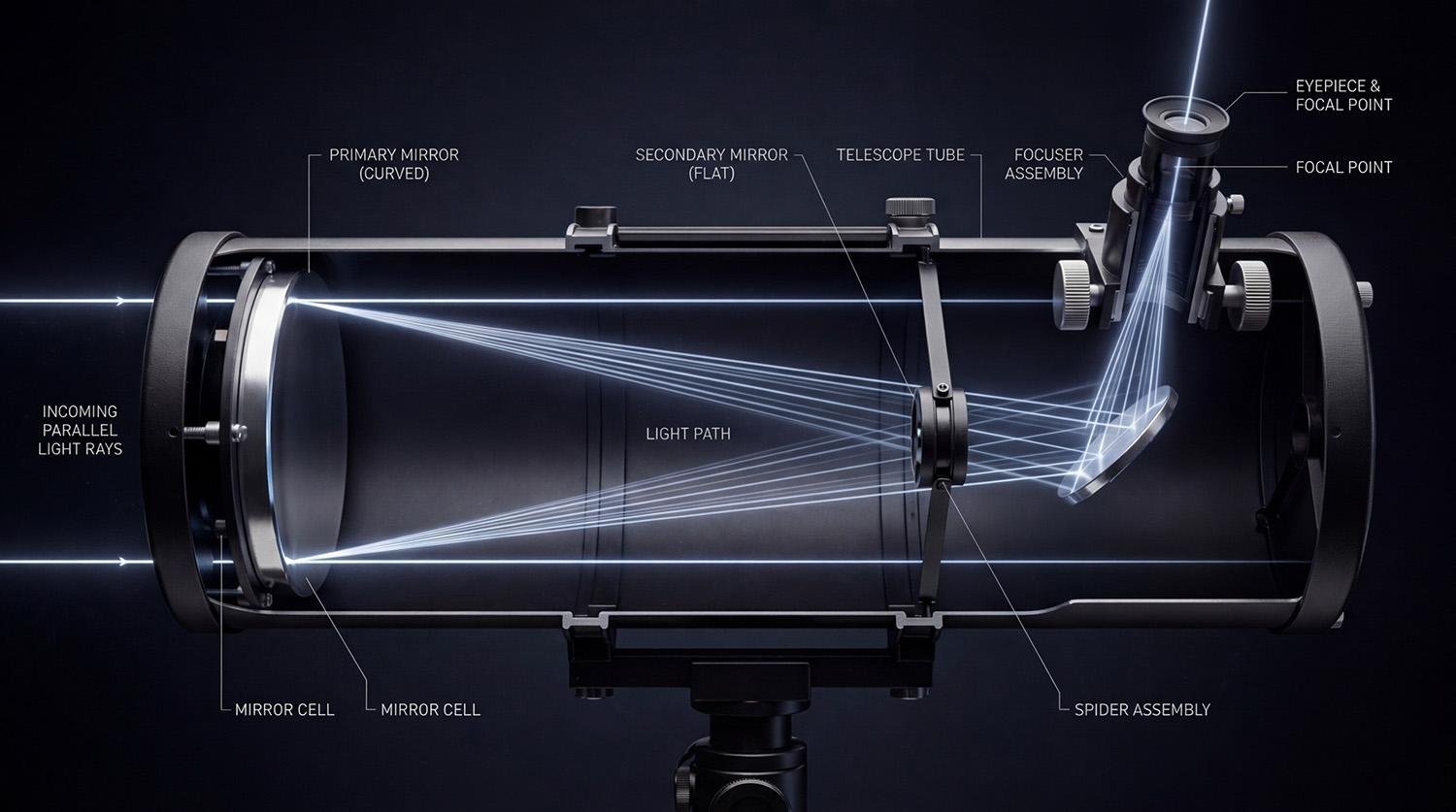
Aperture — the diameter of the primary mirror or lens — is what determines what a telescope can actually show you, not the number printed next to "x" on the box.
The Number on the Box Is Lying to You
Telescope boxes love to advertise magnification: "525x power!" in large type on the front. It's the single most misleading number in the hobby, because magnification is not a fixed property of a telescope — it changes depending on which eyepiece is inserted, and it can be pushed arbitrarily high by adding a shorter-focal-length eyepiece or a Barlow lens. Cranking the number up simply spreads the same amount of light over a larger, dimmer, blurrier image. Past a certain point, more magnification makes the view worse, not better.
What Aperture Actually Does
Aperture is the diameter of a telescope's primary lens or mirror — the light-collecting surface. It's a fixed, physical property of the instrument, and it governs two things that magnification cannot fake: how much light the telescope gathers, and how much fine detail it can resolve. A larger aperture pulls in more photons from a faint object, making dim things visible at all, and resolves detail that a smaller aperture physically cannot separate, no matter how much magnification is applied on top of it.
This is why a 6-inch telescope at a modest, well-chosen magnification consistently shows more than a 3-inch telescope pushed to its advertised maximum "power." The smaller scope has already run out of light and resolution to work with; adding magnification just makes an already-dim, already-blurry image bigger and dimmer still.
The Practical Limit on Useful Magnification
A commonly cited rule of thumb caps useful magnification at roughly 50x per inch of aperture (about 2x per millimeter) under good conditions — a 4-inch telescope tops out usefully around 200x, an 8-inch around 400x. Push past that ceiling and the image doesn't reveal more detail; it just gets bigger, dimmer and softer. Atmospheric turbulence imposes its own ceiling too, regardless of aperture, which is why even large telescopes rarely benefit from magnification much beyond 250–300x on an average night.
What This Means When You're Comparing Telescopes
When evaluating a telescope, the aperture figure — not the magnification claim on the box — is the number worth anchoring on. A 130mm reflector will outperform a 60mm refractor on faint deep-sky targets regardless of what magnification either is marketed at. Mount stability and optical quality matter too, but aperture sets the ceiling on what's physically possible to see before either of those other factors come into play.
Common Mistakes to Avoid
- Choosing a telescope based on advertised magnification numbers rather than aperture in millimeters or inches
- Assuming a Barlow lens or shorter eyepiece will "unlock" better views — past the useful limit, it degrades the image instead
- Comparing two telescopes' advertised maximum magnification instead of comparing their aperture directly
Frequently Asked Questions
For light-gathering and resolution, yes — but portability, cost and mount stability all scale up with aperture too. The "best" aperture is the largest one you'll actually set up and use regularly.
It's an easy number to make sound impressive on packaging, even though it's achievable on almost any telescope simply by adding a shorter eyepiece — regardless of whether the resulting image is actually usable.