How Telescope Mounts Actually Work
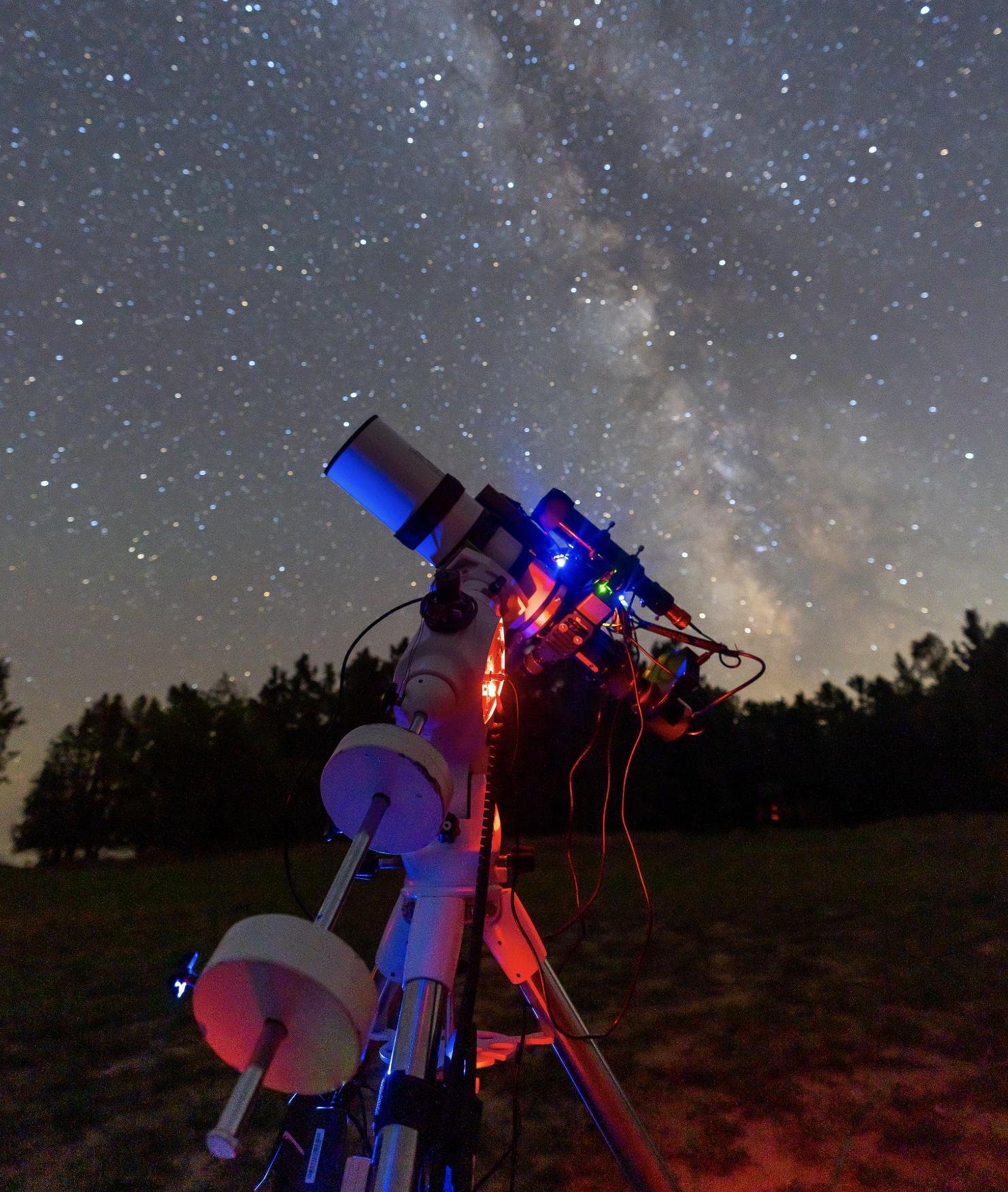
A stable mount matters as much as the optics riding on top of it — a wobbling image is unusable regardless of aperture.
The Mount Is Half the Telescope
It's easy to focus entirely on optics when shopping for a telescope, but the mount underneath determines whether those optics are usable at all. A wobbly mount turns even excellent optics into a frustrating experience — every touch of the focuser sends the image shaking for several seconds, and tracking a target across the sky becomes a fight rather than a pleasure. Understanding what a mount actually does clarifies why this matters so much.
Alt-Azimuth: Up-Down, Left-Right
An alt-azimuth (alt-az) mount moves on two simple axes: altitude (up and down) and azimuth (left and right), the same way a camera tripod head moves. It's intuitive to point — swing toward a target, aim up or down until it's centered — which makes it the natural choice for casual visual observing and the default on most beginner telescopes, including Dobsonian reflectors.
The tradeoff appears once tracking becomes important. As the sky rotates overhead, an alt-az mount has to adjust both axes simultaneously and at varying rates to keep a target centered, and the field of view subtly rotates over time — a non-issue for visual observing, but a real problem for long-exposure astrophotography, where that rotation blurs stars into arcs across a stacked image.
Equatorial: Aligned With the Sky's Own Rotation
An equatorial (EQ) mount tilts one of its axes to align with Earth's rotational axis, pointed at the celestial pole. Once polar aligned, tracking a target requires moving only a single axis at a constant rate — matching Earth's rotation — which keeps the field of view from rotating over time. This is why equatorial mounts, not alt-az mounts, are the standard for long-exposure deep-sky astrophotography.
The cost is complexity: equatorial mounts require a polar alignment step before use, and their tilted geometry can feel less intuitive to point manually compared to an alt-az mount's straightforward up-down, left-right motion.
Why Stability Matters More Than Either Design
Regardless of alt-az or equatorial design, a mount's stability — its resistance to vibration and its ability to smoothly and precisely track — often matters more than which geometry it uses. A rock-solid alt-az mount paired with a modest telescope will out-perform a wobbly, undersized equatorial mount paired with a much better optical tube. Reviewers consistently flag mount quality as the detail beginners underweight relative to optics when making a first purchase.
GoTo and Tracking Motors
Either mount type can be paired with motorized tracking or a computerized "GoTo" system that automatically points at catalogued objects. GoTo adds convenience and, on equatorial mounts, continuous tracking without manual adjustment — but it also adds cost, weight, and another system that can fail or need calibration. Reviewers are split on whether GoTo is worth it for an absolute beginner; many argue that learning to star-hop manually on a simple alt-az mount first builds sky knowledge that's easy to skip past with GoTo.
Frequently Asked Questions
For visual observing only, an alt-az mount (like a Dobsonian) is simpler and more intuitive. For astrophotography beyond very short exposures, an equatorial mount is close to essential.
No — manual alt-az mounts remain a common and effective way to start, and many experienced observers prefer them for casual sessions even after upgrading gear elsewhere.