
Galaxies, Nebulae and Clusters: What's the Difference
This article contains affiliate links. If you buy through them, ORIVON may earn a commission at no extra cost to you.
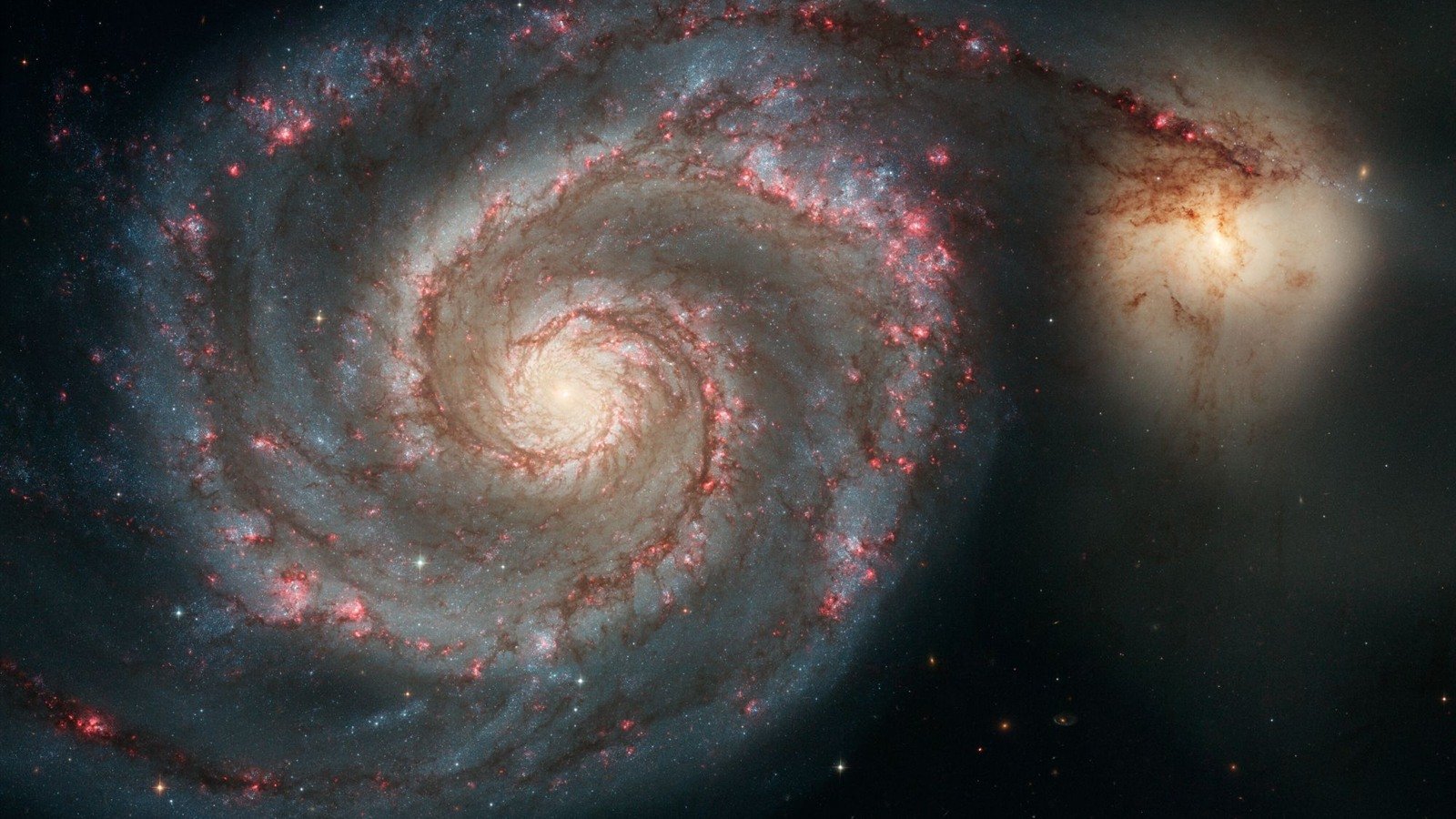
Credit: NASA, ESA, S. Beckwith (STScI), and The Hubble Heritage Team (STScI/AURA)
Three Different Kinds of "Deep Sky" Object
"Deep sky" gets used as a catch-all for anything beyond the solar system, but it actually covers three fundamentally different kinds of objects, at wildly different scales. Knowing which one you're looking at — and what it actually is — turns a vague fuzzy patch into something you understand.
Galaxies
A galaxy is an entire, gravitationally bound system of anywhere from millions to trillions of stars, along with gas, dust and dark matter, separated from other galaxies by enormous stretches of largely empty space. Our own Milky Way is one; the Andromeda Galaxy (M31), visible to the naked eye from a dark site, is the nearest large spiral neighbor. The Whirlpool Galaxy (M51), pictured above, is a textbook example of a face-on spiral, caught mid-interaction with a smaller companion galaxy — its arms visibly warped by the gravitational tug. Through a backyard telescope, most galaxies appear as soft, elongated glows rather than the sharp spiral structure photographs reveal.
Nebulae
A nebula is a cloud of gas and dust within our own galaxy — much smaller and much closer than a galaxy, typically light-years rather than millions of light-years away. Nebulae split into distinct subtypes based on how they interact with light:
- Emission nebulae glow under their own power, ionized by intense radiation from young, hot stars embedded within them. The Orion Nebula (M42) is the classic example — a stellar nursery lit from the inside.
- Reflection nebulae don't glow themselves; they scatter and reflect light from nearby stars, the way dust in a sunbeam becomes visible. They typically appear blue, since blue light scatters more efficiently than red.
- Planetary nebulae are unrelated to planets — the name comes from their round, planet-like appearance in early telescopes. They're the expanding shell of gas a Sun-like star sheds near the end of its life. The Ring Nebula (M57) is a well-known example.
Star Clusters
A cluster is a group of stars born together, still loosely or tightly bound by gravity, and it comes in two very different flavors:
- Open clusters are young, loosely bound groups of a few dozen to a few thousand stars, still relatively close to their birthplace within a spiral arm. The Pleiades (M45) is the most recognizable naked-eye example — a tight knot of hot, young blue stars.
- Globular clusters are ancient, densely packed spheres containing hundreds of thousands of stars, orbiting a galaxy's core rather than sitting within its disk. The Hercules Cluster (M13) is the finest example visible from the northern hemisphere, resolving into a sparkling ball of individual stars in a mid-sized telescope.
Quick Reference
| Galaxy | Millions of stars · millions of light-years away · e.g. M51, M31 |
| Emission Nebula | Glowing gas cloud · light-years away · e.g. M42 Orion Nebula |
| Planetary Nebula | Shell from a dying star · e.g. M57 Ring Nebula |
| Open Cluster | Young, loose star group · e.g. M45 Pleiades |
| Globular Cluster | Ancient, dense star sphere · e.g. M13 Hercules Cluster |
Frequently Asked Questions
It's genuinely difficult for faint, unresolved examples of either — both can appear as soft, elongated smudges. Knowing the object's catalog designation ahead of time, via a star chart or planning app, is more reliable than trying to judge it visually.
Globular clusters are far older and much more densely packed, giving them a compact, roughly spherical shape that resolves into stars only toward the edges at low power. Open clusters are looser and scattered, resolving into individual stars much more easily.