
The Pleiades Explained: Why the Seven Sisters Have More Than 1,000 Stars
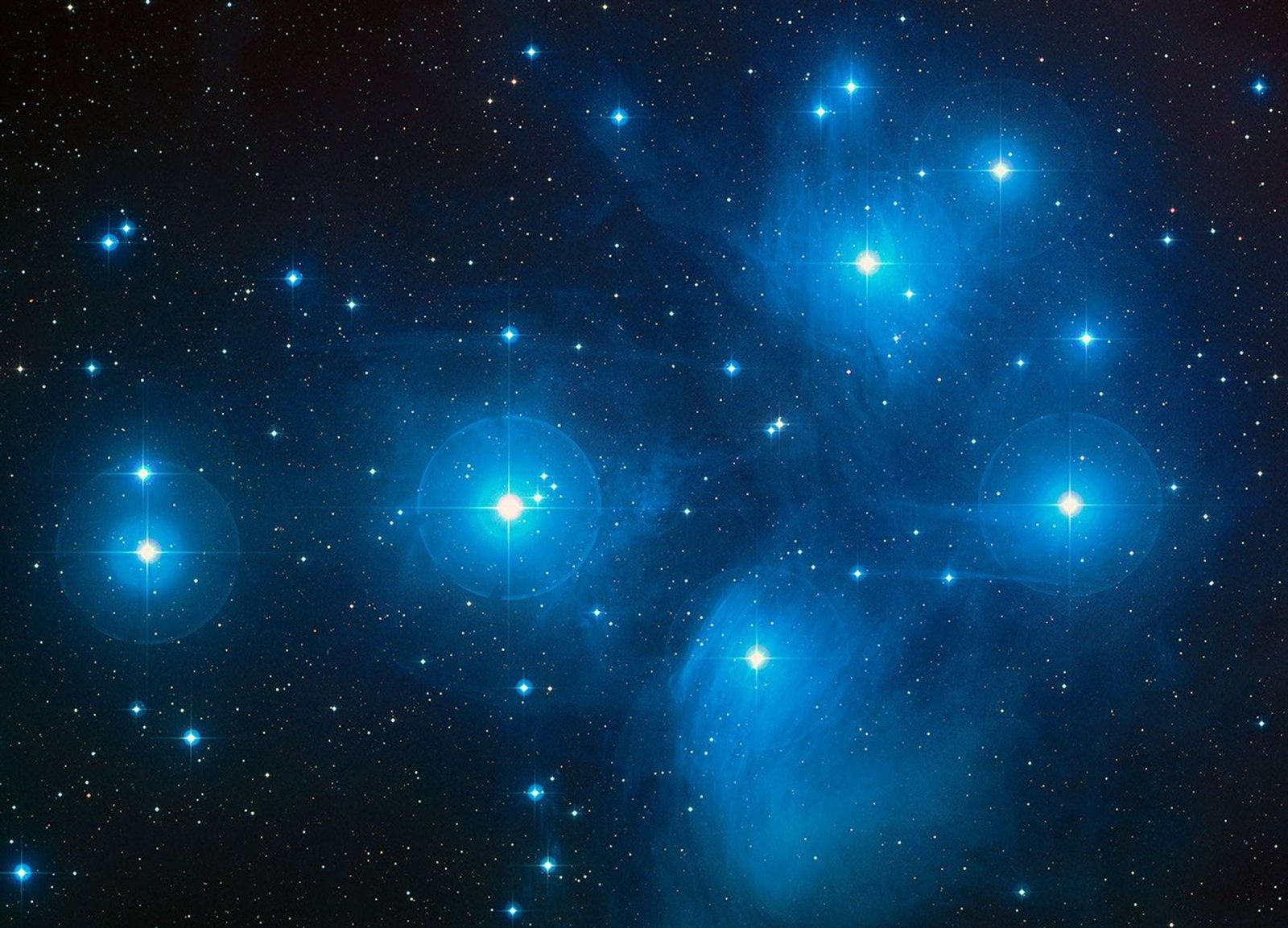
Bright stars and blue reflection nebulosity in the Pleiades star cluster. Long-exposure imagery reveals dust that is much harder to see visually. Credit: NASA, ESA and AURA/Caltech.
What the Pleiades Actually Are
The Pleiades — catalogued as Messier 45, or M45 — are an open star cluster in the constellation Taurus. "Open cluster" is a specific, meaningful classification: it means a loosely bound group of stars that formed together from the same collapsing cloud of gas and dust, still drifting through space as a family, but without the crushing central density of a globular cluster like M13 in Hercules. Open clusters are also relatively young and gravitationally fragile — many eventually disperse as the galaxy's tidal forces pull individual members away over tens or hundreds of millions of years.
It's worth being precise about one more distinction: the Pleiades are a cluster, not a constellation. Taurus, the Bull, is the constellation — a traditional pattern of stars covering a large patch of sky. M45 is a genuine physical cluster sitting inside that pattern, near Taurus's shoulder, made of stars that are actually gravitationally associated with one another, unlike the stars of a constellation, which usually only appear near each other from Earth's vantage point and share no physical connection at all.
Distance and Age, Without False Precision
According to NASA, the Pleiades sit roughly 445 light-years from Earth — though the agency is explicit that this figure "is not universally agreed upon," since different measurement techniques (parallax surveys, cluster-fitting methods, and others) have historically returned slightly different results. Treat any number you see for this cluster's distance as a well-supported estimate rather than a settled figure to the decimal point.
The cluster's age is usually put at around 100 million years, based on modeling how quickly its most massive stars are evolving — young by stellar standards (the Sun, for comparison, is about 4.6 billion years old), which is part of why the Pleiades' brightest members are hot, blue-white stars still burning through their fuel quickly. Published estimates for the exact age vary by method, generally landing somewhere in the range of roughly 75 to 150 million years, so "about 100 million years" is best read as a representative figure, not an exact one.
Why "Seven Sisters" for a Cluster of More Than 1,000 Stars
NASA describes the Pleiades as containing "over a thousand stars that are loosely bound by gravity," with only "a handful of its brightest members visually dominating the cluster." That's the entire explanation for the naming mismatch: the name comes from what people have always been able to actually see, not from a real headcount. Long before telescopes existed, observers picked out a small group of the cluster's brightest stars — traditionally counted as seven — and named the group after them. The other thousand-plus members are real, but they're too faint to register without help.
The cluster has been observed since antiquity, and NASA notes it has no single known discoverer — it's simply been visible, and named, across many cultures for as long as people have looked up. In Greek mythology, the name refers to seven sisters, daughters of the Titan Atlas, transformed into stars. That's the origin most familiar to English-language readers, but it's far from the only tradition attached to this cluster: it also carries independent, long-standing names and cultural significance elsewhere — among them Matariki in Māori tradition, tied to the Māori New Year, and Subaru (すばる) in Japan, a name recognizable today mainly because the car manufacturer took it, and its six-star logo, directly from the cluster. Galileo Galilei was the first person to observe the Pleiades through a telescope, and what he saw — many more stars than are visible by eye — was an early, direct demonstration of exactly the gap this article is about.
Why Different People Count Different Numbers of Stars
Ask five people how many stars they can see in the Pleiades without any optical aid, and you'll likely get five different answers, typically somewhere between five and around a dozen. That spread isn't people making mistakes — it reflects real variables stacking up at once: how dark and clear the sky actually is, how good the observer's eyesight is (particularly for faint point sources), how long their eyes have adapted to the dark, and even how carefully and patiently they look rather than glancing once and counting quickly. Under an average suburban sky, six or seven stars is a typical, unremarkable result — which is exactly consistent with the traditional name. Under a genuinely dark sky, with time for the eyes to adjust, sharper-eyed observers routinely report considerably more, since additional cluster members cross the threshold of visibility as sky glow drops and pupils dilate further.
The Blue Nebulosity: Dust the Cluster Happens to Be Passing Through
Long-exposure photographs of the Pleiades typically show delicate blue wisps wrapped around its brightest stars — a reflection nebula. This is one of the more commonly misunderstood parts of the Pleiades: the dust is not left over from the formation of the cluster's own stars. Instead, current understanding is that the cluster is simply passing through an unrelated cloud of interstellar dust it happens to be moving through right now, and starlight is scattering off that dust to produce the visible blue glow — blue rather than another color for the same physical reason Earth's daytime sky is blue: shorter wavelengths of light scatter more efficiently than longer ones.
NASA's own description adds a specific, verifiable detail about how that dust is structured: near stars like Merope, "the smaller dust particles are slowed down by the star's radiation pressure more than the larger particles are" as the cloud moves toward the star — meaning the light pressure from the star itself is actively sorting the dust by particle size as the two interact. It's a genuinely active, physical process, not just a static backdrop.
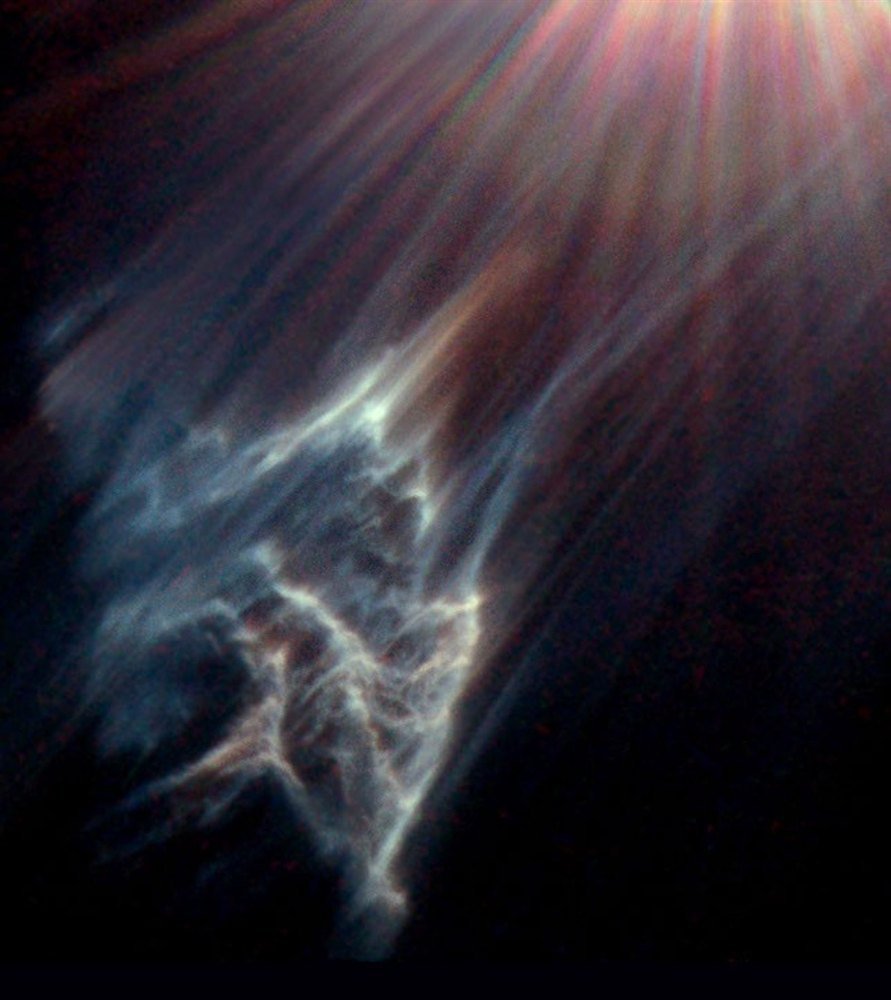
Hubble's close-up of a dusty cloud near Merope in the Pleiades. Radiation from the nearby star shapes the illuminated material. Credit: NASA and The Hubble Heritage Team (STScI/AURA); acknowledgment: George Herbig and Theodore Simon (Institute for Astronomy, University of Hawaii).
How to Find the Pleiades — From Either Hemisphere
The Pleiades sit at a declination of roughly +24°, which means they're comfortably visible from most inhabited latitudes on Earth, in both hemispheres — though not from the same height in the sky, and not necessarily the same direction, depending on where you're standing.
From the Northern Hemisphere: the Pleiades pass high overhead for mid-latitude observers, making them one of the easier deep-sky objects to casually notice — a small, distinctive, slightly smudged-looking clump of stars that doesn't match any single constellation shape. Orion, the recognizable hunter with the three-star belt, rises in roughly the same part of the sky in the same season and is one of the most reliable nearby landmarks; the bright orange star Aldebaran, marking the eye of Taurus the Bull, sits along a rough line from Orion's belt in the general direction of the Pleiades, with M45 continuing further along past Aldebaran.
From the Southern Hemisphere: the same cluster is real and observable, but it sits lower toward the northern part of the sky rather than passing overhead, since Southern Hemisphere latitudes look "up and over" the celestial equator to reach objects near +24° declination. It's still an easy naked-eye object under reasonable sky conditions — just don't expect it in the same part of the sky, or at the same time of night, that Northern Hemisphere guides describe. There is no single "up" that applies everywhere; orient yourself by the constellation Taurus and Orion's belt relative to your own local horizon rather than assuming a fixed direction.
Best Time of Year and Time of Night
Because Earth orbits the Sun, every deep-sky object has a season when it's conveniently placed in the evening sky, and other times of year when it's only up before dawn, or not up at all during dark hours. For the Pleiades, Northern Hemisphere observers get their most convenient evening views during winter months, when the cluster climbs high not long after sunset — but it's actually observable, at some hour of the night, across a much longer stretch of the year than that single season suggests, since it also rises late at night or appears before dawn during other months. Exactly when the Pleiades clear your horizon on a specific night depends on your latitude, the date, and how much sky glow or terrain blocks your view close to the horizon — variables that shift meaningfully by location and are worth checking rather than assuming. ORIVON Sightline calculates this directly for your location and the current date, rather than relying on a generic seasonal rule of thumb.
What to Expect: Naked Eye, Binoculars and Telescope
Naked eye: under reasonably dark skies, expect to pick out somewhere around six to nine individual points of light in a small, distinctive clump — genuinely one of the most recognizable naked-eye sights in the sky once you know where to look, and one of the few deep-sky objects that doesn't require any equipment at all to appreciate.
Binoculars: this is arguably the single best way to view the Pleiades, and a case where more magnification is not an improvement. A pair of ordinary binoculars reveals dozens of additional cluster members invisible to the naked eye, while still framing the entire cluster in one comfortable field of view — something most telescopes, with their narrower fields, struggle to do at all.
Telescope: here the Pleiades punish high magnification. The cluster spans roughly 2° of sky — about four times the apparent width of the full Moon — so a telescope used at moderate-to-high power, the way you might view a planet or a small nebula, will only frame a small piece of it at a time. A telescope paired with a low-power, wide-field eyepiece is a genuinely different, more rewarding experience than the same instrument cranked up in magnification.
Seeing the Stars vs. Detecting the Nebulosity
It's worth being explicit about a distinction that trips up a lot of first-time observers: seeing the Pleiades' stars and seeing the Pleiades' nebulosity are two very different levels of difficulty, and succeeding at one does not mean you'll succeed at the other. The stars are genuinely easy — bright enough for casual naked-eye viewing from most locations. The blue reflection nebulosity is a different matter entirely: it's faint, low-contrast light spread over a wide area, and for the overwhelming majority of observers and equipment, it stays invisible even through a telescope from anything but an exceptionally dark sky. Photographs showing prominent blue wisps around the cluster's stars are almost always the product of long-exposure imaging, not a description of what that same photographer saw by eye at the eyepiece in the moment.
Why Photographs Show So Much More Than the Eye Ever Will
This gap between photograph and eyepiece comes down to a basic difference in how a camera sensor and a human retina handle faint light. The eye essentially processes light in real time — it doesn't accumulate or store incoming photons over multiple seconds to build up a picture, so extremely faint light, like the Pleiades' nebulosity, simply never crosses the threshold of visibility no matter how long you stare. A camera sensor, by contrast, can hold its shutter open for tens of seconds or minutes at a time (or stack many exposures together, effectively multiplying that further), continuously collecting and adding up photons that arrive one at a time. That accumulated light is exactly what reveals the reflection nebula in photographs, and exactly what makes the visual and photographic experience of the same object so different that they can feel like two different targets entirely.
Frequently Asked Questions
More than a thousand, according to NASA — but only a handful are bright enough to notice without magnification. The "Seven Sisters" name refers to what a careful observer can typically pick out by eye, not the cluster's real population.
Star counts depend on eyesight, sky darkness and how carefully you look. Under an average suburban sky most people pick out six or seven; under a genuinely dark sky, sharp-eyed observers have reported a dozen or more, since additional cluster members become bright enough to separate from the background.
Roughly 445 light-years, per NASA — though the agency notes this distance isn't universally agreed upon across different measurement methods. Treat it as a well-supported estimate, not a settled-to-the-decimal figure.
A reflection nebula — starlight scattering off a cloud of interstellar dust the cluster happens to be passing through right now. The dust isn't material left over from the stars' own formation; it's an unrelated cloud the Pleiades are moving through.
Realistically, only in photos for almost every observer. The nebulosity is faint enough that it needs a genuinely dark sky and, in most cases, long-exposure imaging to become visible at all — a naked-eye or even telescopic view overwhelmingly shows stars, not glow.
From the Northern Hemisphere, the Pleiades climb highest in the evening sky during winter months, though they're visible for a much longer stretch of the year in the pre-dawn and late-night sky. Check ORIVON Sightline for exactly when the cluster clears your local horizon on a given night.
Sources & Methodology
Distance, star population, age context and the explanation of the reflection nebula's dust dynamics are drawn from NASA's Hubble Space Telescope Messier catalog entry for M45 (science.nasa.gov). General open-cluster classification, naming history and cross-cultural context reflect widely documented astronomical and cultural background rather than a single source. Observing guidance (naked-eye/binocular/telescope expectations, field-of-view considerations) reflects general, well-established amateur-astronomy practice rather than a specific hands-on ORIVON observing session.