
Hercules Cluster (M13): One of the North's Brightest Globulars
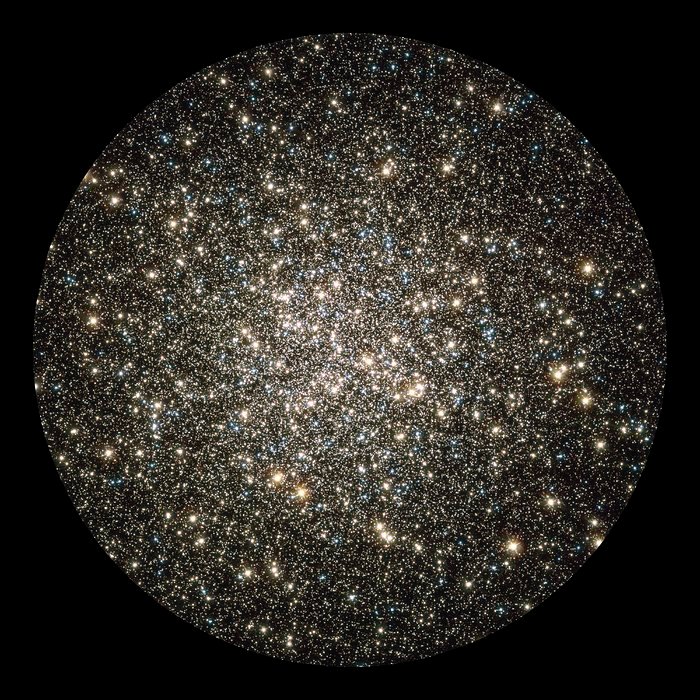
Credit: NASA, ESA, and the Hubble Heritage Team (STScI/AURA)
What It Is
Messier 13 is a globular cluster — a tightly packed, roughly spherical swarm of several hundred thousand stars bound together by gravity, all far older than the Sun. Unlike an open cluster's loose scatter, a globular cluster's stars crowd so densely toward the center that individual stars become difficult to separate even through a telescope, giving it the glowing, ball-like appearance that makes globulars instantly recognizable.
Constellation & Distance
M13 sits in the constellation Hercules, roughly 22,000 to 25,000 light-years from Earth — one of the brightest globular clusters visible from the Northern Hemisphere, and a frequent target for both new and experienced observers.
Why It's Worth Seeing This Month
Hercules rides high overhead for most of the night during Northern Hemisphere summer, putting M13 in an easy, comfortable position without needing to wait for a particular hour or contend with a low horizon. It's bright enough to remain a rewarding target even from suburban skies, and even modest aperture starts resolving individual stars around its edges.
Equipment: Visual vs. Astrophotography
Visual: A 4-inch telescope already shows M13 as more than a fuzzy ball, with outer stars beginning to resolve individually. An 8-inch or larger aperture reveals a genuinely dense, sparkling core — one of the more dramatic upgrades in detail that additional aperture buys in this hobby.
Astrophotography: Because M13 is compact and bright, it doesn't demand the long total exposure times a faint nebula needs. What it does reward is focal length and resolution — a longer focal length instrument reveals more of the cluster's internal structure than a short, wide-field setup built for larger targets.