
ZWO ASI585MC Pro Review (2026): Is It Worth It?
This article contains affiliate links. If you buy through them, ORIVON may earn a commission at no extra cost to you.
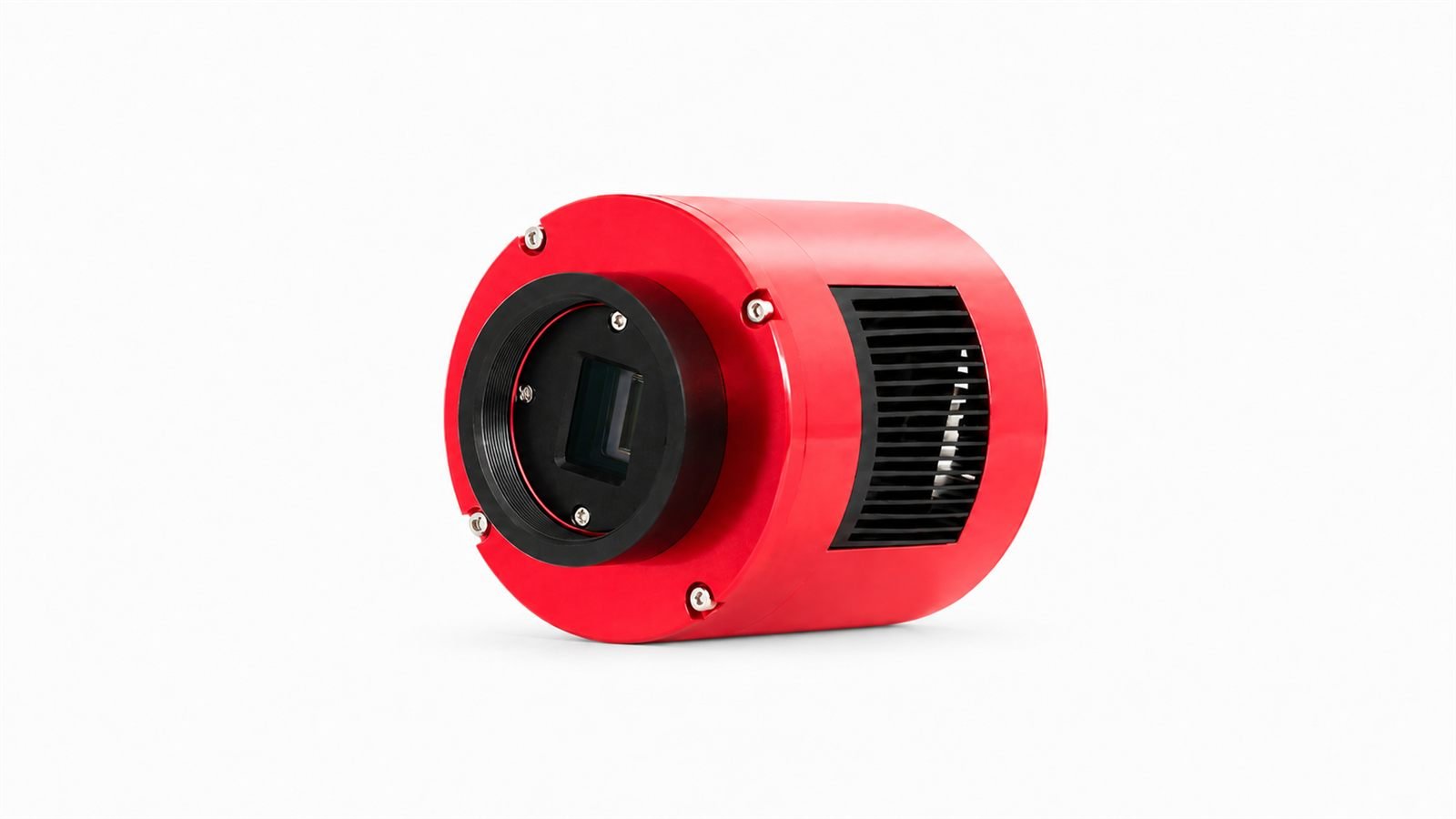
The ZWO ASI585MC Pro, ZWO's most affordable cooled color astro camera.
Short Answer
Yes, for a specific and increasingly popular role: it's ZWO's most affordable genuinely cooled camera, built around a small, fast, low-noise sensor that independent reviewers report shows no amp glow — a real contrast with ZWO's own ASI294MC Pro. Its case narrows quickly for anyone who wants a wide field of view on large nebulae and galaxies, where its small 1/1.2″ sensor is a genuine limitation the price doesn't erase.
Editor's Verdict
Based on ZWO's current specifications and recurring findings across independent reviews — not on direct hands-on testing by ORIVON — the ASI585MC Pro earns its recommendation as an entry point into cooled dedicated astrophotography, and as a genuinely dual-purpose deep-sky-and-planetary camera, rather than as a universal upgrade from every other ZWO camera.
What the ASI585MC Pro Is
The ASI585MC Pro is a cooled, one-shot-color astronomy camera built around Sony's IMX585 sensor — the same sensor generation behind several recent budget-friendly astro cameras, here paired with ZWO's two-stage thermoelectric cooling. "Pro" in ZWO's naming means cooled, distinguishing it from an uncooled ASI585MC variant; the cooling is what makes long deep-sky exposures viable by holding the sensor well below ambient temperature through a session.
Key Specifications
| Sensor | Sony IMX585, back-illuminated (STARVIS 2), 1/1.2″ (11.2 × 6.3 mm) |
| Resolution | 8.29 MP (3840 × 2160), 2.9 µm pixels |
| ADC | 12-bit |
| Full Well Capacity | 40Ke (color version) |
| Read Noise | As low as 0.7 e⁻ |
| Quantum Efficiency | Peak ~91% |
| Frame Rate | Up to 47fps at full resolution |
| Cooling | Two-stage TEC, 35°C below ambient |
| Buffer | 512MB DDR3 |
| Connection | USB 3.0 |
| Power | External 12V DC, 3–5A |
| Price (current) | $599 USD — see Price & Value below |
Why the IMX585 Sensor Matters
The IMX585 is a modern, back-illuminated Sony sensor (Sony's STARVIS 2 generation) that has become popular across several recent budget astro cameras specifically because it combines strong quantum efficiency, genuinely low read noise and a high frame rate in one design — a combination that used to require trading one for the others at this price point.
Sensor Size and Field of View
At 1/1.2″ (11.2 × 6.3mm), the sensor is physically smaller than both the ASI533MC Pro's 1″ square sensor and the ASI294MC Pro's Micro Four Thirds sensor. Independent guidance on properly matching this camera to a telescope points toward shorter focal lengths — roughly 250–600mm — to get a reasonable pixel scale (around 1.0–2.0 arcseconds per pixel) and field of view; compact refractors in the William Optics RedCat/GT-series class are frequently cited as a natural pairing.
2.9 µm Pixels: What Setups They Suit
Smaller pixels than the ASI533MC Pro's 3.76µm mean this sensor benefits from shorter, faster-focal-ratio optics rather than long, slow ones — oversampling (too many pixels per arcsecond of actual resolution) becomes a real risk on long focal lengths, which is part of why independent guidance points toward the shorter-focal-length telescope range above.
Cooling
ZWO specifies the two-stage TEC cooler at up to 35°C below ambient — matching the cooling depth of ZWO's more expensive Pro-series cameras, meaning this budget-tier camera doesn't compromise on thermal noise suppression to hit its price.
Read Noise, HCG and Dynamic Range
ZWO's current specifications list read noise as low as 0.7 e⁻ and a 40Ke full well capacity for the color version (the monochrome ASI585MM Pro is specified marginally lower, at 38.7Ke). Independent comparison against the ASI533MC Pro notes this camera's dynamic range runs narrower than the 533's — a real trade-off for the frame-rate and price advantage, not a spec ZWO or independent reviewers dispute.
Zero Amp Glow
This is one of the more consistently repeated findings across independent hands-on testing: unlike the ASI294MC Pro, which shows amp glow in individual sub-exposures (removed by dark-frame calibration), the ASI585MC Pro is reported to show no amp glow at all — one real, practical calibration headache this camera simply doesn't have. ZWO's own material describes hardware-level amp glow elimination in the sensor design.
Deep-Sky Imaging
Within its field-of-view limits, independent hands-on results include real, documented deep-sky captures — Sharpless 112 and the Crescent Nebula are specifically cited in one published review, built from dozens of multi-minute subs — demonstrating the camera performs as a genuine deep-sky imager, not merely a fast planetary camera with cooling bolted on.
Emission Nebulae / Dual-Band Use
As a one-shot-color camera, it follows the same narrowband/dual-band tradeoffs as ZWO's other color Pro cameras — a Bayer filter blocks some narrowband light before it reaches each pixel, so a dedicated mono setup with individual filters remains the more efficient tool for pure narrowband work, while a dual-band filter on this camera remains a legitimate, documented way to shoot emission nebulae from light-polluted skies without a filter wheel.
Broadband Galaxies
For broadband color imaging, the limiting factor is field of view rather than sensitivity — this camera can resolve galaxy detail well within its sensor's real estate, but the small sensor means larger galaxies and galaxy groups will crop more tightly than on the ASI294MC Pro or ASI2600MC Pro at the same focal length.
Planetary and Lunar Imaging
This is where the ASI585MC Pro stands apart from ZWO's other cooled deep-sky cameras: independent reviewers specifically highlight its near-47fps full-resolution frame rate as making it a genuinely capable planetary and lunar camera as well as a deep-sky one — a rare dual-purpose case at this price, since most dedicated deep-sky cameras trade away frame rate for larger pixels and sensors.
Calibration
Standard cooled-camera calibration practice still applies — flats and darks at matched gain/temperature/exposure settings — but independent testing notes one practical simplification: because amp glow isn't a factor here, dark-frame calibration has one less artifact to specifically account for compared to the ASI294MC Pro.
Power and Cabling
ZWO specifies external 12V DC power at 3–5A for the cooling system, in addition to the USB 3.0 data connection — the same two-cable reality as ZWO's other Pro cameras, and worth planning a field power solution for before the first session.
USB Hub
Like ZWO's other current Pro cameras, it includes USB 3.0 connectivity with sufficient bandwidth (5Gbps) to sustain its full-resolution, high-frame-rate output without bottlenecking — relevant specifically because of how much data a near-47fps planetary capture session can generate.
ASIAIR / Software Workflow
As a ZWO camera, it's natively supported by ZWO's own ASIAIR ecosystem and by common third-party capture platforms (N.I.N.A., SharpCap), the same on-ramp ZWO's other cooled cameras use.
What the ASI585MC Pro Does Especially Well
Independent reviewers converge on two specific strengths: no reported amp glow (a genuine calibration-workflow simplification), and real dual-purpose capability across deep-sky and fast planetary/lunar imaging in one camera — an unusual combination at this price.
Real Limitations
The small 1/1.2″ sensor is a genuine, not marketing-spin, limitation for wide-field deep-sky work — independent guidance is consistent that this camera wants shorter focal lengths to avoid a cropped, oversampled result. A UV/IR-cut filter is required for accurate color but isn't included in the box, an added cost some buyers overlook. Its 12-bit ADC and narrower dynamic range than the ASI533MC Pro are real trade-offs for the price and frame rate.
Who Should Buy It
Based on this editorial synthesis of current specifications and independent reviews — not on direct hands-on testing by ORIVON — the ASI585MC Pro makes the most sense for imagers moving up from a DSLR who want a genuinely cooled first astro camera at the lowest price ZWO currently offers for that, paired with a short-focal-length refractor, and for anyone who wants one camera that can credibly do both deep-sky and fast planetary/lunar imaging.
Who Should Skip It
Imagers who already own or plan to use a longer-focal-length telescope, or who specifically want the widest comfortable field of view for large nebulae and galaxies, are better served by the physically larger ASI294MC Pro (see comparison below) despite the higher price.
ASI585MC Pro vs. ASI533MC Pro
The ASI533MC Pro uses a similarly compact 1″ square sensor but with larger 3.76µm pixels and, per independent comparison, meaningfully wider dynamic range — at a higher current price and a lower maximum frame rate (around 20fps versus this camera's near-47fps). For buyers prioritizing dynamic range and a square sensor over frame rate and price, the ASI533MC Pro remains the stronger deep-sky-only choice; the ASI585MC Pro wins on price and on genuine planetary/lunar crossover capability.
ASI585MC Pro vs. ASI294MC Pro
The ASI294MC Pro's Micro Four Thirds sensor is physically much larger, giving a materially wider field of view at the same focal length — the deciding factor for anyone imaging large nebulae or galaxy groups — at a higher current price and with documented (if calibration-removable) amp glow the ASI585MC Pro doesn't have. ORIVON's full ASI294MC Pro review covers that camera in the same depth as this page.
ASI585MC Pro vs. ASI2600MC Pro
The ASI2600MC Pro's APS-C sensor is larger again, at a current price running several times higher than the ASI585MC Pro's — a step reserved for buyers who've already outgrown smaller-sensor cameras and have the budget for it, not a realistic head-to-head comparison for a buyer choosing their first cooled camera.
Pros
What Reviewers Praise
- No reported amp glow — a real calibration-workflow simplification versus the ASI294MC Pro
- Genuinely dual-purpose: capable deep-sky imaging and near-47fps planetary/lunar capture in one camera
- ZWO's most affordable currently-sold cooled camera, with the same 35°C cooling depth as pricier Pro models
- Documented real-world deep-sky results (Sharpless 112, Crescent Nebula) from independent testing
Cons
Common Criticisms
- Small 1/1.2″ sensor genuinely limits field of view — wants a short-focal-length telescope to avoid oversampling
- 12-bit ADC and narrower dynamic range than the ASI533MC Pro
- Requires a separately-purchased UV/IR-cut filter for accurate color
- Requires external 12V power and dedicated capture software, same as ZWO's other Pro cameras
Price and Value
At the time of this August 2026 update, ZWO's own current listing prices the ASI585MC Pro at $599 USD — cross-referenced against independent retailer pricing at the same figure. At that price, with no reported amp glow and genuine planetary crossover capability, independent reviewers describe it as a strong first-cooled-camera value. Third-party retailer prices fluctuate — check the current price before buying rather than treating this figure as fixed.
Final Verdict
The ASI585MC Pro earns its growing reputation as ZWO's accessible entry point into cooled astrophotography — the combination of no amp glow, real cooling depth and genuine planetary/lunar crossover at this price is a legitimately unusual value proposition. Its small sensor is a real, not cosmetic, limitation for wide-field deep-sky work; buyers who need that wider field should budget for the ASI294MC Pro instead. For a first cooled camera behind a short-focal-length refractor, or as a dual-purpose deep-sky-and-planetary camera, it's a sound, current recommendation.
How It Compares
| Camera | Sensor | Max Frame Rate | Current Price (est.) |
|---|---|---|---|
| ZWO ASI585MC Pro | 1/1.2″ | ~47fps | $599 |
| ZWO ASI533MC Pro | 1″ (square) | ~20fps | ~$700–$800 |
| ZWO ASI294MC Pro | Micro Four Thirds | ~19fps | ~$999–$1,100 |
Prices are current-market estimates as of August 2026, drawn from ZWO's own published pricing and cross-referenced against third-party retail listings. They fluctuate — always check the retailer's live price before buying.
Sources & Methodology
This review combines ZWO's current official specifications, independent hands-on reviewer findings and recurring patterns in owner feedback. ORIVON has not tested this camera directly — no claim here should be read as a hands-on ORIVON finding. Editorial synthesis (positioning, comparisons, "who should buy" guidance) is ORIVON's own analysis built on the sourced facts below, not itself an external claim.
- Official specifications: ZWO USA, ASI585MC/MM Pro product page and ZWO official store listing (accessed August 2026)
- Independent hands-on review: AstroBackyard, "ZWO ASI585MC Pro | ZWO's Most Affordable Cooled Camera" — amp glow behavior, real-world deep-sky results, comparison to the ASI533MC Pro and ASI294MC Pro
- Owner and long-term feedback: patterns observed across current retailer buyer reviews
- ORIVON editorial analysis: positioning against the ASI533MC Pro, ASI294MC Pro and ASI2600MC Pro, "who should/shouldn't buy" guidance, and current-value assessment
Frequently Asked Questions
For a first cooled astro camera on a budget, or for a fast planetary/lunar imager that can also do deep-sky work, yes — independent reviewers consistently recommend it for that role. Buyers who need a wide field of view on larger nebulae and galaxies are better served by the physically larger ASI294MC Pro.
The ASI533MC Pro has a similarly small sensor but larger pixels and reportedly wider dynamic range, at a higher price. The ASI294MC Pro has a meaningfully larger Micro Four Thirds sensor for wider fields of view, also at a higher price. The ASI585MC Pro is ZWO's most affordable cooled option, trading sensor size and dynamic range for price and frame rate.
Independent hands-on testing reports no amp glow on this camera, a contrast with ZWO's own ASI294MC Pro, which does show amp glow in individual subs (removed by calibration).
Yes — ZWO specifies up to 47fps at full resolution, and independent reviewers specifically highlight this as a genuinely dual-purpose camera, unusual for a cooled deep-sky camera at this price.
Yes — like ZWO's other cooled cameras, it requires a connected computer or compatible mini-PC running capture software such as ASIAIR, N.I.N.A. or SharpCap; it doesn't record internally like a standard camera.