DSLR vs. Dedicated Astro Camera: Where a Cooled Sensor Actually Earns Its Cost
This article contains affiliate links. If you buy through them, ORIVON may earn a commission at no extra cost to you.
The Core Difference
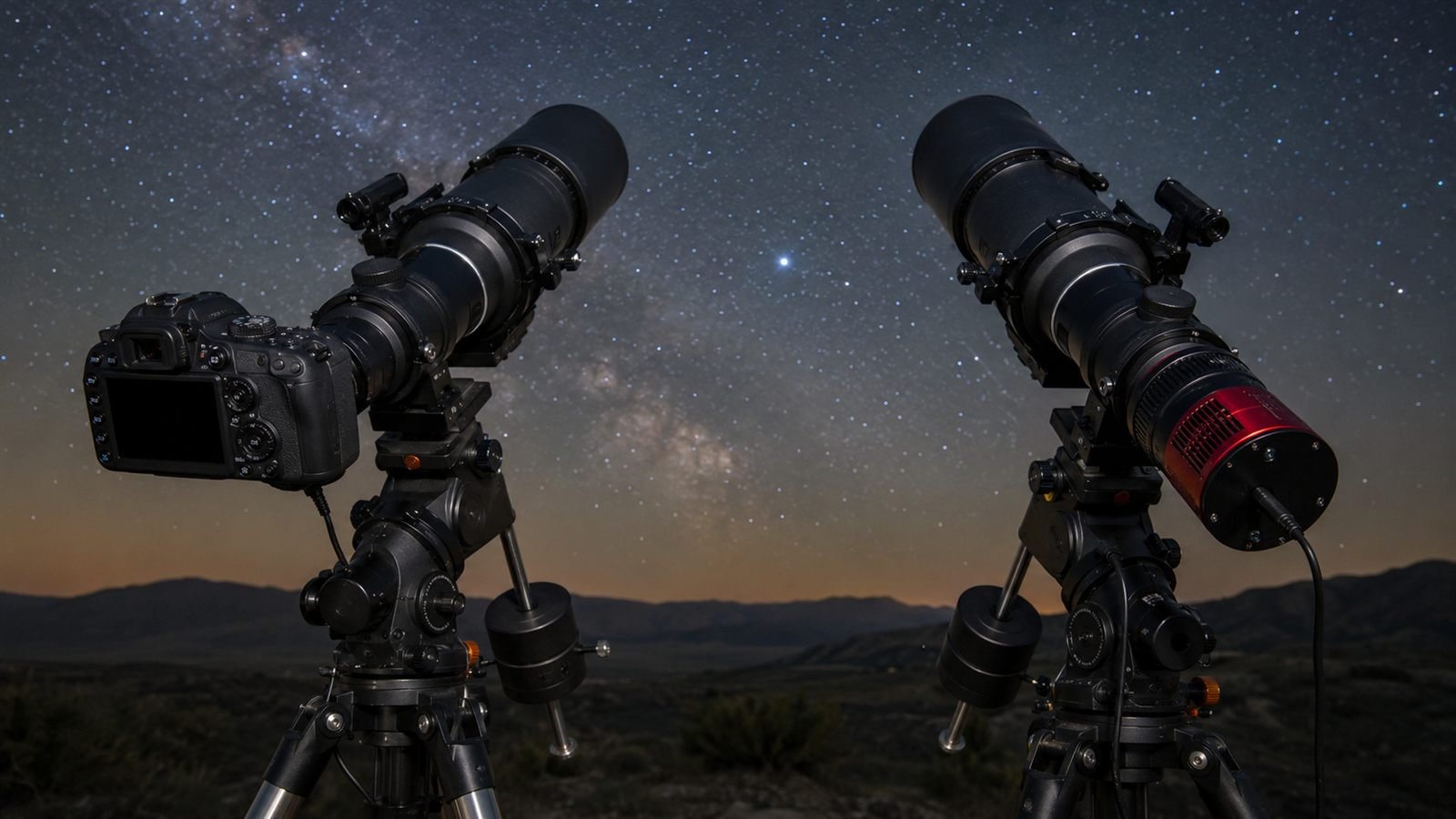
A DSLR or mirrorless camera is a general-purpose imaging tool that happens to work for astrophotography — it shoots regular photos just as well, and if you already own one, the cost of trying deep sky imaging is effectively zero. A dedicated astro camera does one thing: it's built to sit at the back of a telescope and capture the sky as efficiently as possible, usually with a cooled sensor that suppresses the thermal noise that builds up during long exposures. That single design difference — cooling — is where most of the price gap comes from.
| Factor | DSLR / Mirrorless | Dedicated Astro Camera |
|---|---|---|
| Initial cost | Often $0 — already owned | Additional, dedicated purchase |
| Versatility | Everyday photography too | Astrophotography only |
| Deep sky image quality | Good, noise-limited | Better, especially in warm conditions |
| Learning curve | Familiar controls | New software, new workflow |
When a DSLR Makes Sense
If you already own a DSLR or mirrorless camera, it's the obvious place to start. It costs nothing extra to try, it's versatile enough to double as your everyday camera, and modern sensors are genuinely capable of solid deep sky images with the right technique. Most imagers' first successful astrophotos, and a good number of the images that first hooked them on the hobby, come from a camera they already owned.
When a Dedicated Astro Camera Makes Sense
The point to upgrade tends to arrive when thermal noise becomes your limiting factor rather than your technique — warm-weather sessions, exposures stretching past a few minutes, or faint targets where every bit of signal matters. A cooled sensor holds its temperature steady, which keeps noise low regardless of ambient conditions, and dedicated astro cameras are typically more sensitive to the specific wavelengths deep sky targets emit. It's a single-purpose tool, but for the purpose it's built for, it outperforms a general-purpose camera at the same price point.
Upgrade when noise is genuinely holding your images back, not because a dedicated camera exists. A DSLR you use every clear night beats a cooled camera that intimidates you into staying inside.
Frequently Asked Questions
Not to start. A stock DSLR captures most targets well; astro-modification mainly improves sensitivity to a specific red wavelength common in emission nebulae.
Cooling helps most in warm conditions, but it provides consistent, predictable noise performance year-round, which is valuable even in cold climates.