
Sky-Watcher Star Adventurer GTi Review (2026): Worth It?
This article contains affiliate links. If you buy through them, ORIVON may earn a commission at no extra cost to you.
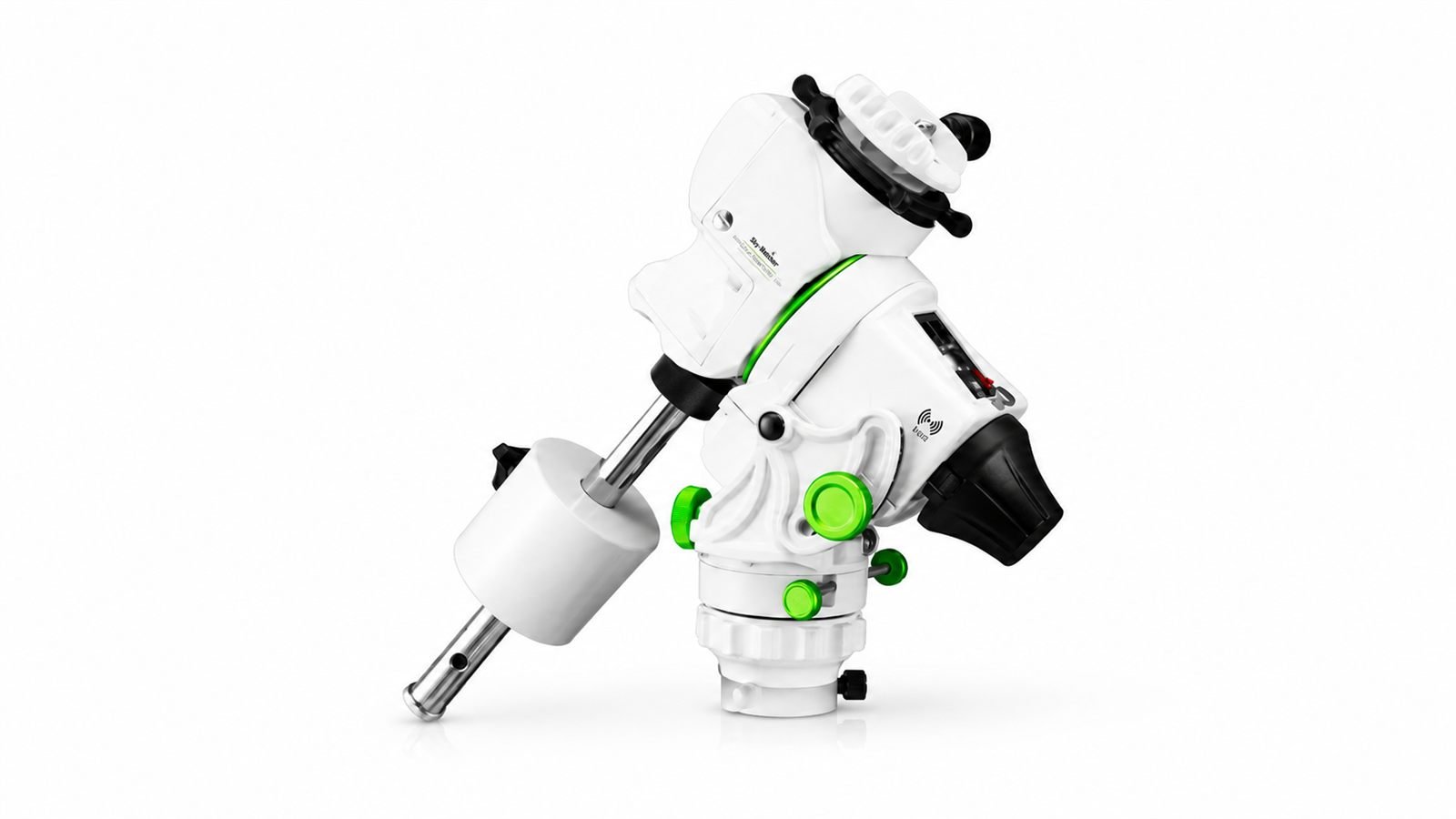
The Sky-Watcher Star Adventurer GTi, a compact two-axis GoTo equatorial mount.
Short Answer
Yes, for a buyer who specifically wants automatic GoTo object-finding in a genuinely portable, two-axis equatorial mount. It is not simply the Star Adventurer 2i with Wi-Fi bolted on — it's a different category of product, with motorized RA and DEC axes and full computerized control. Independent reviewers document real, usable results with mirrorless cameras, telephoto lenses and compact refractors, with the honest caveat that the included tripod is the weakest link in the kit.
Editor's Verdict
Based on Sky-Watcher's current specifications and recurring findings across independent reviews — not on direct hands-on testing by ORIVON — the Star Adventurer GTi earns its recommendation as a genuine, compact GoTo equatorial mount for wide-field and short-focal-length astrophotography, not as a universal upgrade path from every star tracker below it.
What the Star Adventurer GTi Is
The Star Adventurer GTi is Sky-Watcher's compact two-axis, GoTo-equipped equatorial mount — a genuinely different product category from the single-axis Star Adventurer 2i tracker, built for photographers and beginner astrophotographers who want automatic object-finding and motorized tracking on both axes in a package that still travels reasonably well.
Where It Sits in Sky-Watcher's Lineup
Below it sits the single-axis Star Adventurer 2i (see the critical distinction below); above it sit Sky-Watcher's larger, heavier full GoTo equatorial mounts (the EQ6-class and beyond) built for larger telescopes and dedicated astro cameras. The GTi occupies a specific middle position: real GoTo and two-axis motorization, in a mount still light enough to travel with.
What Comes in the Kit
Sky-Watcher sells this mount in two distinct configurations, and mixing up their contents is a real, documented source of buyer confusion:
| S20590 — Mount Head Kit | Mount head, dual counterweights (1.5 lb + 3.5 lb) and counterweight bar only. No tripod. No camera dovetail. |
| S20595 — Mount Kit | Everything in the Head Kit, plus Sky-Watcher's steel tripod and pier extension. No camera dovetail. |
Neither configuration includes a dovetail plate for attaching a camera or telescope — that's a separate purchase either way. This review, and the Amazon listing linked below, cover the S20595 full Mount Kit with tripod.
Build and Portability
The mount head alone weighs approximately 5.7 lb, with compact 227 × 227 × 125mm dimensions — genuinely travel-friendly for a two-axis GoTo mount. One independent hands-on review specifically flags the included steel tripod as the kit's weakest component, describing it as "a little light-duty for the application," recommending a weighted spreader tray and retracted legs to keep vibration in check rather than treating the stock tripod as sufficient on its own for demanding imaging.
11 lb Payload: What It Actually Means
Sky-Watcher rates the GTi at 11 lb (5 kg). That is a manufacturer capacity rating, not a guaranteed long-exposure imaging ceiling — independent hands-on testing backs it up for real setups well within that number: a mirrorless camera with a 300mm telephoto lens produced documented 60-second unguided exposures, and compact refractors in the William Optics RedCat 61 / Radian 61 class are specifically cited as working well. ORIVON is not aware of a documented, universally-agreed percentage of rated payload that's "safe" for long exposures on this mount, and does not invent one here — the practical guidance from independent testing is that real imaging setups (camera, lens or small scope, guide camera) sit comfortably within the rating with proper balance, rather than requiring you to approach the stated maximum.
RA + DEC Motorization
Unlike a single-axis tracker, the GTi motorizes both the right ascension and declination axes — the mechanical basis for both its GoTo capability and for dithering/guiding corrections on both axes during long exposures, not just compensating for Earth's rotation on one.
GoTo
Full GoTo object-finding is the mount's defining feature versus the 2i — point it at a target from the SynScan Pro app's database and the motors slew both axes to find it, after a star-alignment routine. Independent reviewers describe the GoTo slewing as smooth and responsive, with adjustable slew speeds.
Tracking
Sky-Watcher specifies multiple pre-programmed tracking rates including sidereal, solar and lunar — the same core tracking-rate set as Sky-Watcher's single-axis trackers, now delivered through motorized, computer-controlled axes rather than a single fixed-speed motor.
Polar Alignment
A built-in illuminated polar scope handles the initial alignment step, with reviewers noting the SynScan Pro app's simulated polar-scope view and brightness control make the process quick — one independent account describes final manual altitude/azimuth adjustment to center Polaris as taking about a minute once the app-guided setup is done.
SynScan Pro
SynScan Pro is Sky-Watcher's free companion app (iOS and Android) and the primary way most owners will control the GTi — star alignment, target selection from its object database, and slewing all run through it over Wi-Fi. A separate physical SynScan hand controller is available as an optional accessory for those who prefer dedicated hardware over a phone.
Wi-Fi Workflow
Control is Wi-Fi-based rather than requiring a cable to a phone or tablet, which independent reviewers describe as meaningfully more convenient in the field than a wired or button-based interface, particularly for star alignment and target selection.
Autoguiding
An ST-4 autoguider port is built in, and independent testing pairing the mount with a dedicated autoguiding system (a ZWO ASIAIR Plus, in one documented case) reports genuinely strong results — total RMS guiding error in the 1.0–2.0 arcsecond range, respectable performance for a mount in this size and price class.
Computer-Control Potential
Beyond the SynScan Pro app, the mount's USB interface and standard SynScan command protocol mean it can be integrated into more advanced computer-controlled imaging setups (via ASCOM/INDI-compatible software) for buyers who outgrow phone-app control, though most owners are expected to use SynScan Pro directly.
DSLR + Lens Imaging
This is comfortably within the GTi's design intent — a mirrorless or DSLR body with a wide-to-moderate telephoto lens is well within the payload rating and benefits directly from GoTo for framing and from two-axis tracking for longer exposures than a single-axis tracker comfortably supports.
Telephoto Imaging
Documented results at 300mm focal length (60-second unguided exposures) demonstrate real telephoto capability; independent guidance suggests autoguiding becomes worthwhile for pushing exposure times further at this focal length range, consistent with the ST-4 port's inclusion.
Small Refractor Imaging
Compact refractors — the RedCat 61 and Radian 61 are specifically documented — are cited as working well within the payload rating. Independent reviewers are consistent, though, that focal lengths beyond roughly 600–700mm push past what this mount's servo-motor design (rather than precision stepper motors used in larger mounts) is built to handle well.
Dedicated Astro Camera Use
A dedicated cooled astro camera (such as ZWO's ASI-series) on a short-focal-length refractor is within the realistic use case this mount is built for, provided total payload (camera, guide camera, cabling) stays comfortably within the rating and the telescope stays on the shorter end of the focal-length range above.
Wide-Field Deep Sky
For wide-field deep-sky targets — larger nebulae, star clusters — at short focal lengths, this is where the GTi's combination of GoTo framing convenience and genuine two-axis tracking pays off most clearly over a single-axis tracker.
Power
Sky-Watcher specifies eight AA batteries or external 12V DC power (2.1mm connector) — a real consideration for a session's length, since GoTo motors on both axes draw more power than a single-axis tracker's one motor; an external 12V power source is worth planning for extended sessions.
Setup
Independent reviewers describe the overall setup routine — polar alignment via the app-assisted polar scope, then a star-alignment routine for GoTo accuracy — as approachable, with the compact design enabling reasonably fast field deployment once the routine is familiar.
Learning Curve
Beyond basic tracker use, a GoTo mount introduces genuinely new concepts — star alignment, GoTo accuracy troubleshooting, balancing on two axes rather than one — that a 2i owner wouldn't need to learn; independent reviews treat this as an expected part of stepping up to a GoTo mount, not a defect. One documented firmware quirk (a battery indicator that flashes low prematurely) is noted as a minor, non-critical annoyance.
Travel
The mount head alone remains genuinely travel-friendly at 5.7 lb; the full kit with the steel tripod adds real bulk versus a single-axis tracker's typical travel footprint, so travelers prioritizing absolute minimum size and weight should weigh that against the GoTo capability gained.
Real Limitations
The included stock tripod is independently flagged as this kit's weakest link, needing extra care (weighting, retracted legs) for demanding imaging rather than performing flawlessly out of the box. Servo motors rather than precision steppers mean independent reviewers cap realistic use at roughly 600–700mm focal length, not longer. The 11 lb payload, like any manufacturer rating, is a capacity ceiling rather than a comfortable long-exposure imaging target.
Who Should Buy It
Based on this editorial synthesis of current specifications and independent reviews — not on direct hands-on testing by ORIVON — the Star Adventurer GTi makes the most sense for a beginner or intermediate astrophotographer who specifically wants automatic GoTo object-finding and genuine two-axis tracking, paired with a wide-to-moderate telephoto lens or a compact short-focal-length refractor, and who is willing to budget for a sturdier tripod if pushing the mount toward demanding imaging.
Who Should Skip It
Photographers who don't need GoTo and want the smallest, lightest possible travel kit are better served by the simpler Star Adventurer 2i or the even smaller iOptron SkyTracker Pro. Imagers planning to use telescopes longer than roughly 600–700mm focal length need a larger, stepper-motor-driven equatorial mount instead.
Star Adventurer GTi vs. Star Adventurer 2i
This is the single most important distinction in this review: the 2i is a portable single-axis star tracker — it rotates around one axis to counter Earth's rotation, full stop, with no motorized declination and no GoTo. The GTi is a compact two-axis, computerized GoTo equatorial mount — motorized on both axes, with full automatic object-finding through SynScan Pro. It is not "the 2i plus Wi-Fi"; the GTi is heavier, costs more, and does a genuinely different job. Independent comparison describes the GTi as addressing "nearly every issue" reviewers had with the 2i specifically because it adds real DEC motorization and a more robust equatorial wedge, not merely a software layer. ORIVON's full Star Adventurer 2i review covers the simpler single-axis tracker in the same depth as this page — read that one first if you're not sure you need GoTo at all.
Star Adventurer GTi vs. SkyGuider Pro
iOptron's SkyGuider Pro is, like the 2i, a single-axis tracker without GoTo — smaller, lighter and cheaper than the GTi, but without motorized DEC or automatic object-finding. The comparison only makes sense as "GoTo vs. no GoTo, at a real price and weight difference," not as two equivalent competing mounts. ORIVON's full SkyGuider Pro review covers it directly.
Star Adventurer GTi vs. Larger EQ Mounts
Sky-Watcher's own larger equatorial mounts (EQ6-class and above) use precision stepper motors, carry substantially more payload, and are built for longer-focal-length telescopes and dedicated deep-sky imaging rigs — at a real cost, weight and portability penalty the GTi doesn't have. The GTi's case is specifically compactness and travel-friendliness with real GoTo, not competing head-to-head with mounts built for a permanent or semi-permanent imaging setup.
Pros
What Reviewers Praise
- Genuine two-axis GoTo in a mount head that still weighs about 5.7 lb
- Documented real imaging results: 60-second unguided exposures at 300mm, strong sub-2″ RMS guiding with a dedicated autoguider
- SynScan Pro's Wi-Fi control described as smooth, responsive and easy to learn
- Works well with compact refractors (RedCat 61 / Radian 61 class) as well as camera-and-lens setups
Common Criticisms
- Included steel tripod is independently flagged as the kit's weakest component, needing extra stabilization for demanding work
- Servo motors cap realistic use at roughly 600–700mm focal length
- Two SKUs (head-only vs. full kit with tripod) that are easy to mix up when comparing prices
- No camera dovetail included in either configuration
Price and Value
As of September 14, 2026, Sky-Watcher USA's own listings price the S20590 Head Kit (no tripod) at $720 and the S20595 full Mount Kit (with steel tripod and pier extension) at $830 — both up meaningfully from the $579 and $679 this page cited after checking in late August 2026. Treat all of these as snapshots, not fixed numbers — check the current price on whichever retailer you're buying from before purchase.
Final Verdict
The Star Adventurer GTi delivers on its core promise: genuine, compact, two-axis GoTo tracking that independent testing backs up with real imaging results, not just a spec sheet. Its honest weak point is the included tripod, worth budgeting to reinforce or upgrade if you're pushing the mount toward serious imaging. For a beginner or intermediate astrophotographer who specifically wants GoTo and real DEC tracking without stepping up to a full-sized EQ mount, it's a sound, current recommendation — just go in clear that it's a meaningfully bigger, more capable (and more expensive) product than the Star Adventurer 2i, not a Wi-Fi update to it.
How It Compares
| Model | Axes | GoTo | Current Price (est.) |
|---|---|---|---|
| Star Adventurer GTi (S20595, w/ tripod) | Two (RA+DEC) | Yes | $830 |
| Star Adventurer GTi (S20590, head only) | Two (RA+DEC) | Yes | $720 |
| Star Adventurer 2i Pro Pack | One (RA) | No | $585 |
| iOptron SkyGuider Pro | One (RA) | No | ~$359–$539 |
Prices are current-market estimates as of August 2026, drawn from each manufacturer's own listings and cross-referenced against retail sources. They fluctuate — always check the retailer's live price before buying.
Sources & Methodology
This review combines Sky-Watcher's current official specifications, independent hands-on reviewer findings and recurring patterns in owner feedback. ORIVON has not tested this mount directly — no claim here should be read as a hands-on ORIVON finding. Editorial synthesis (positioning, comparisons, "who should buy" guidance) is ORIVON's own analysis built on the sourced facts below, not itself an external claim.
- Official specifications: Sky-Watcher USA, Star Adventurer GTi Mount Kit (S20595) and Mount Head Kit (S20590) product pages (accessed September 14, 2026)
- Independent hands-on reviews: AstroBackyard, "Sky-Watcher Star Adventurer GTi | Complete Review"; TelescopicWatch, "Sky-Watcher Star Adventurer GTi Mount Review" — payload, GoTo/guiding performance, tripod quality, focal-length limits
- Owner and long-term feedback: patterns observed across current retailer buyer reviews
- ORIVON editorial analysis: positioning against the Star Adventurer 2i, SkyGuider Pro and larger EQ mounts, "who should/shouldn't buy" guidance, and current-value assessment
Frequently Asked Questions
For a beginner who wants automatic object-finding and a real two-axis equatorial mount in a genuinely portable package, yes — independent reviewers consistently recommend it for that role. Buyers who don't need GoTo, or want the smallest possible travel kit, are better served by the simpler, lighter Star Adventurer 2i.
No. The 2i is a single-axis tracker — it rotates around one axis to counter Earth's rotation. The GTi is a genuinely two-axis, motorized equatorial mount with full GoTo, computerized object-finding and a more robust equatorial wedge. They serve meaningfully different use cases, not the same one with an added feature.
S20590 is the mount head kit alone, without a tripod. S20595 is the full mount kit, including Sky-Watcher's steel tripod and pier extension. They are priced differently and the tripod is not interchangeable-by-default between the two listings.
Sky-Watcher rates 11 lb (5kg) payload. Independent hands-on testing documents solid results with a mirrorless camera and a 300mm lens, and with compact refractors in the RedCat 61/Radian 61 class — real-world imaging setups sit comfortably within the rating with proper balance, not right at its edge.
No — it's controlled via Sky-Watcher's free SynScan Pro app over Wi-Fi from a phone or tablet. A separate SynScan hand controller is available but optional, and computer control is possible for advanced automation.