Total Solar Eclipse 2026: Path, Times, Safety and What to Expect
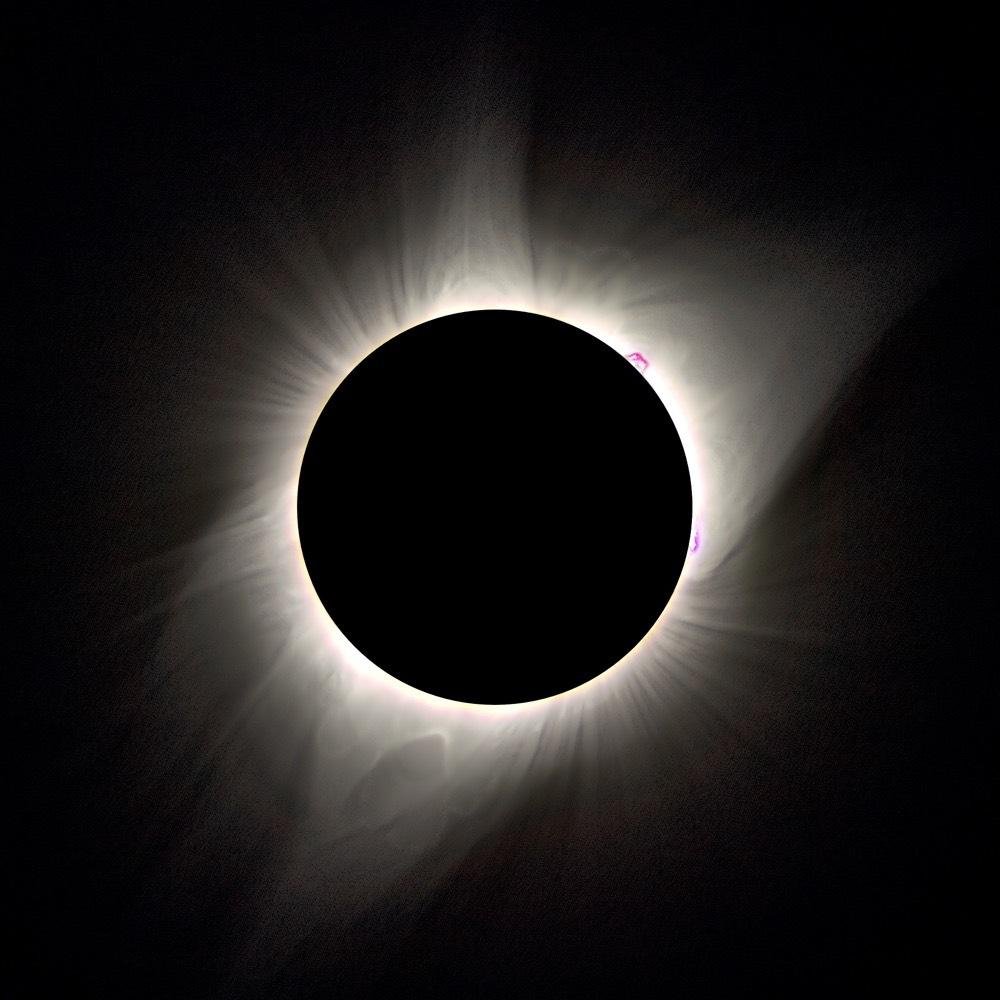
Total solar eclipse, August 21, 2017 (illustrative — not the August 2026 eclipse). Credit: NASA / Carla Thomas
This eclipse took place on August 12, 2026. This page is ORIVON's original pre-event planning guide, kept as a historical reference — the path, timing and safety information below describe what was predicted, not a live event.
Read the recapOn August 12, 2026, the Moon's shadow crossed the Arctic and North Atlantic before reaching Iceland and Spain, bringing totality back to mainland Europe for the first time in decades.
Inside the narrow path of totality, daylight briefly collapsed into twilight and the Sun's corona appeared around the black silhouette of the Moon. Outside that path, millions of observers across Europe, Canada, northern parts of the United States and northwestern Africa saw a partial solar eclipse instead.
This guide — written before the event — explains where the eclipse was predicted to be visible, how the timing was calculated for different locations, what totality was expected to look like, and how to watch a solar eclipse safely. It's preserved here as a reference; for what was actually confirmed about the event, see ORIVON's eclipse recap.
Why the August 12 Eclipse Matters
Mainland Europe hasn't seen a total solar eclipse since 1999, which is what makes this one significant beyond the usual novelty of the event. Totality itself is brief — at most a little over two minutes at any single location — but it's a categorically different experience from a partial eclipse, not just a more extreme version of one. A partial eclipse dims the daylight and puts a bite-shaped shadow over the Sun. Totality is the only moment the Sun's corona, its faint outer atmosphere, becomes visible at all — and the only moment it's safe to look at the Sun without any filter. For visual observers and astrophotographers alike, that distinction is the whole point of traveling into the path rather than staying just outside it.
Where the Total Eclipse Was Visible
The path of totality was a narrow band, only a few hundred kilometers wide, that swept across a mostly remote and oceanic route: the high Arctic and northern Russia, Greenland, western Iceland, a long stretch of open Atlantic Ocean, and then northern Spain before clipping a small area of extreme northeastern Portugal. Spain and that sliver of Portugal were the only places on the European mainland positioned to see totality.
Being close to the path was not the same as being inside it. Even a location just outside the boundary would only have seen a deep partial eclipse, not totality.
Because the path was so narrow, the difference between a front-row view and a merely deep partial eclipse came down to a matter of kilometers for anyone planning their observing location. NASA's 2026 eclipse overview and Time and Date's interactive eclipse map both document the actual boundary of totality for reference.
Where the Eclipse Was Partial
Well beyond the path of totality, a partial solar eclipse was visible across most of Europe, much of Canada, the northern portions of the United States, and northwestern Africa. A partial eclipse is worth watching in its own right — the Sun visibly bitten into a crescent is not a common sight — but it's a fundamentally different event from totality, and there is no moment during any partial eclipse, anywhere, when it's safe to look at the Sun without certified eye protection.
Eclipse Timing (As Predicted)
There was no single "eclipse time" that applied everywhere — timing shifted by location, and so did how much of the Sun was covered. What stayed consistent, wherever the eclipse was observed from, was the sequence of phases: first contact (the Moon first touches the Sun's edge), the start of totality (inside the path only), maximum eclipse (the point of greatest coverage), the end of totality, and final contact (the Moon fully clears the Sun).
Pre-event eclipse circumstances for specific locations were published by Time and Date's eclipse timing tool and the maps from NASA and the National Solar Observatory.
In Spain specifically, the eclipse occurred late in the day, with the Sun low over the horizon and totality arriving close to sunset — which made an unobstructed western horizon more important there than for a midday eclipse elsewhere on the path.
What Totality Was Expected to Look Like
The partial phase leading up to totality unfolds gradually over roughly an hour for any total solar eclipse — easy to miss if you're not watching for it. As the crescent of the Sun narrows, sunlight passing through gaps in tree canopies starts projecting hundreds of tiny crescent shapes onto the ground — a pinhole-camera effect worth watching for on its own. In the final minutes, daylight takes on a strange, flattened quality, and the temperature can noticeably drop.
Totality itself begins abruptly for any observer inside the path. The last sliver of sunlight vanishes, and the Sun's corona — normally lost in the glare of the photosphere — appears as a pale halo around the black disc of the Moon. It ends just as abruptly, with a brilliant point of light reappearing at the Moon's edge. Whether stars, planets or other specific phenomena become visible depends on local sky conditions and light pollution, and isn't guaranteed at every location. ORIVON did not observe this specific eclipse firsthand and is not claiming what any particular location actually experienced — this section describes the general, predictable phenomenology of totality.
- Eclipse glasses are not ordinary sunglasses, no matter how dark they look.
- Safe viewers for direct, unaided viewing must comply with the ISO 12312-2 standard.
- Inspect every viewer for scratches or punctures before use — a damaged filter is not safe.
- Never look through unfiltered cameras, binoculars or telescopes at the Sun.
- Eclipse glasses do not make unfiltered magnifying optics safe — the concentrated light can burn through the filter itself.
- Cameras, binoculars and telescopes require an appropriate solar filter, securely mounted over the front of the optic.
- Solar protection may be removed only during complete totality, and only from inside the path of totality.
- The moment any bright part of the Sun reappears, protection must be replaced immediately.
- Outside the path of totality, protection stays on for the entire eclipse, start to finish.
Prepare Your Viewing Equipment
What you need depends on how you plan to watch. For direct, naked-eye viewing, ISO 12312-2 certified eclipse glasses or handheld solar viewers are the standard choice. For cameras, telescopes or binoculars, a full-aperture solar filter — sized and mounted securely over the front element, not the eyepiece — is required for every phase outside totality. A pinhole projector is a safe, equipment-free alternative that projects an image of the eclipse rather than requiring anyone to look toward the Sun at all. If you're photographing the event, a tripod and a remote shutter release make a real difference in sharpness, especially during the brief totality window when light changes quickly. Whatever gear you're using, confirm the physical fit of any filter — on the lens, telescope or binoculars — well before eclipse day, not for the first time that morning.
How Location Planning Worked for This Eclipse
This was ORIVON's original pre-event planning advice, preserved for reference and for anyone researching how to plan for a future total solar eclipse using the same general approach:
- Verify that your chosen location is genuinely within the path of totality, using an official interactive map — not a rough glance at a small static image.
- Confirm the exact local timing for that specific location, since it can differ meaningfully from a nearby town.
- For an eclipse low on the horizon like this one was in Spain, prioritize a clear, unobstructed view in the Sun's direction.
- Arrive well before first contact — traffic into popular viewing areas can be significant on eclipse day.
- Have a backup location in mind in case your primary spot turns out to be inaccessible or crowded.
- Check for any local access restrictions, closures or event permits well ahead of time.
- Review the weather forecast in the days immediately before the eclipse, and be ready to move if cloud cover looks likely.
- Don't rely on a single mobile data connection for last-minute map or forecast checks — networks can get overloaded in crowded viewing areas.
ORIVON did not recommend specific towns or viewing sites, and has no verified information on which locations experienced clear skies on the day.
Watching From Outside the Path
A partial eclipse is still genuinely worth seeing, but it's worth setting expectations correctly: the corona doesn't become visible, the sky doesn't darken the way it does during totality, and certified solar protection remains mandatory for the entire event, without exception. This applies to any partial solar eclipse, not just this one.
Final Checklist (As Originally Published)
- Confirm whether you are inside or outside the path of totality.
- Save the exact local times for your location offline, in case of poor connectivity on the day.
- Inspect all viewers and filters for damage before use.
- Secure filters over the front of every optical device you plan to use.
- Choose an unobstructed observing location.
- Charge batteries and clear memory cards the night before.
- Arrive early to account for traffic and crowds.
- Stop looking immediately if anything about a viewer or filter seems unsafe.
Conclusion
The difference between a partial eclipse and totality was never a matter of degree — it was a different experience entirely. This guide's location-planning and solar-safety advice remains generally accurate for any future total solar eclipse, even though the August 12, 2026 event itself has passed; see ORIVON's recap for what was actually confirmed about it.
Frequently Asked Questions
The path of totality crossed the Arctic, Greenland, Iceland, the North Atlantic, northern Spain and a small part of northeastern Portugal. Only locations physically inside that narrow band experienced totality. See ORIVON's recap for what happened.
Only as a partial eclipse, and only from northern parts of the country. The path of totality did not cross the continental United States.
Up to roughly 2 minutes and 18 seconds at the point of greatest eclipse, per pre-event predictions. Duration was shorter toward the edges of the path and depended on the exact observing location.
No. Only eclipse glasses or handheld viewers certified to the ISO 12312-2 standard are safe for direct viewing, at any point outside totality.
Only if you are physically inside the path of totality, and only for the brief window when the Moon fully covers the Sun. The instant any part of the Sun's surface reappears, protection must go back on immediately.
Yes. A dedicated solar filter must be securely mounted over the front of the optic — the large end, not the eyepiece — for every moment outside totality.
Use an interactive eclipse map, such as the ones published by NASA or Time and Date, and enter your specific location — timing and duration shift significantly even within the same region.