The Veil Nebula: Shockwave From an Ancient Supernova
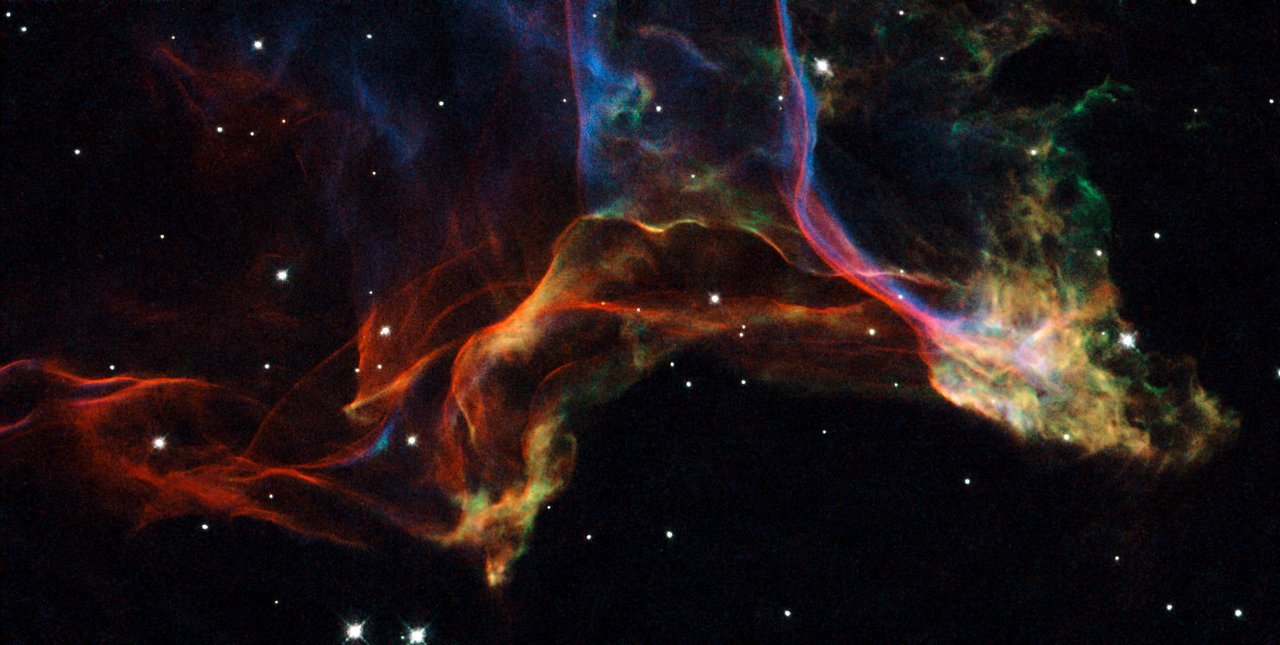
Credit: NASA, ESA, Hubble Heritage Team
What It Is
The Veil Nebula is a supernova remnant — the expanding wreckage of a massive star that exploded roughly 8,000 years ago. What remains is a delicate, filamentary shell of glowing gas, still spreading outward and interacting with the surrounding interstellar medium. It's one of the larger, more intricate remnants visible from Earth, and a favorite target for imagers drawn to its lace-like structure.
Constellation & Distance
The Veil sits in Cygnus, roughly 2,100 light-years away. It spans a large area of sky — several times the apparent width of the full Moon — but its light is spread thin across that area, making it one of the fainter large-scale targets in this list.
Why It's Worth Seeing This Month
Cygnus climbs well into the evening sky during Northern Hemisphere summer, placing the Veil in a comfortable position for a July session. Its faintness rewards patience and dark-sky conditions more than most targets on this list, but the payoff — intricate, wispy filament structure — is distinctive once it becomes visible.
Equipment: Visual vs. Astrophotography
Visual: This is a genuinely challenging naked-eyepiece target. Larger aperture helps, but a UHC or OIII narrowband filter matters more than raw telescope size — it suppresses skyglow and passes the specific wavelengths the nebula emits, often being the difference between seeing structure and seeing nothing at all.
Astrophotography: A wide-field setup captures more of the nebula's sprawling structure in a single frame, and a narrowband filter is close to essential for pulling contrast out of such a faint, extended target. Longer total integration time pays off more here than on smaller, brighter objects.