SVBONY SV220 Dual-Band 7nm Filter Review: What Buyers and Critics Are Saying
This article contains affiliate links. If you buy through them, ORIVON may earn a commission at no extra cost to you.
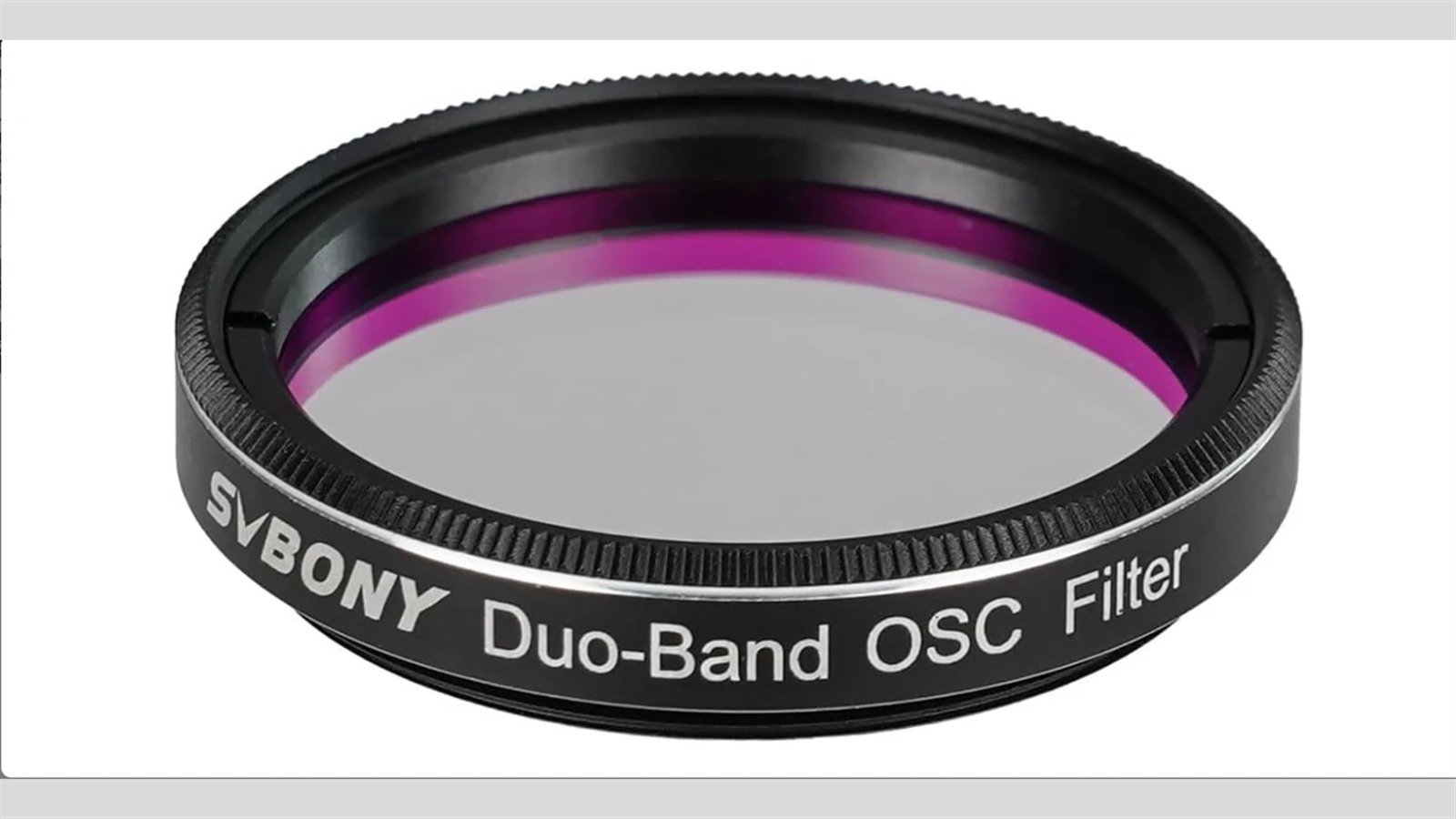
The SVBONY SV220 Dual-Band 7nm, a filter isolating the Hydrogen-alpha and Oxygen III emission lines.
Overview
Light pollution is the single biggest obstacle for city-based astrophotographers, and dual-band filters like the SV220 are the most common answer to it. Rather than blocking light pollution broadly, the SV220 passes only two narrow slices of the spectrum — Hydrogen-alpha and Oxygen III — the exact wavelengths that emission nebulae actually glow in, while rejecting most of the sodium and mercury vapor light that washes out city skies. It's designed for one-shot-color cameras, so it produces a full-color image without a filter wheel.
This assessment draws on the SV220's manufacturer specifications and recurring patterns across published reviews and buyer feedback, organized around the questions someone actually deciding on a light pollution filter would ask.
Technical Specifications
| Bandwidth | 7nm |
| Passbands | Hydrogen-alpha and Oxygen III (dual-band) |
| Compatibility | One-shot-color cameras |
| Filter Thread | 1.25" |
| Price | Approximately $130–$150 USD |
Pros and Cons
Drawing on published tests and recurring themes in buyer feedback, a few points come up consistently:
What Reviewers Praise
- Recovers usable contrast in heavily light-polluted skies, commonly cited up to Bortle 7–8
- Price-to-value frequently described as among the best in the dual-band category
- Simplifies post-processing since it captures both target wavelengths in a single exposure, without combining separate narrowband frames
Common Criticisms
- Reduces overall image brightness, requiring longer exposure times to compensate
- Doesn't replace a single narrowband filter for imagers chasing maximum signal on a specific target
- Color results are frequently described as needing adjustment in post-processing to look natural
Editor's Verdict
Taken together, the published reviews and buyer sentiment position the SV220 as one of the most commonly recommended entry points into dual-band imaging for city-based astrophotographers — the contrast recovery in light-polluted skies is described consistently and isn't treated as an exaggerated claim. The brightness trade-off and post-processing adjustment are treated as expected characteristics of the dual-band approach generally, not shortcomings specific to this filter.
Who It's For
Based on this editorial analysis of the available reviews and specifications — not on direct testing by ORIVON — the SV220 appears to make the most sense for imagers shooting from light-polluted locations with a one-shot-color camera who want emission nebulae to become viable targets again, without adopting a full narrowband filter-wheel workflow. Imagers under genuinely dark skies, or those chasing maximum detail on a single target, are the group most likely to want a different filter strategy.
How It Compares
| Filter | Bandwidth | Type | Price |
|---|---|---|---|
| SVBONY SV220 | 7nm | Dual-band (Ha + OIII) | ~$140 |
| Optolong L-eNhance | ~7nm | Dual-band (Ha + OIII) | ~$200 |
| Astronomik UHC | Broader | Broadband | ~$250 |
Frequently Asked Questions
Yes — it's designed for one-shot-color sensors, which includes both DSLRs and one-shot-color dedicated astro cameras.
Reviewers commonly report needing meaningfully longer total integration time to compensate for the light the filter blocks, though the exact amount varies by target and sky conditions.
Not well — galaxies emit broadly across the spectrum rather than at the specific Ha/OIII wavelengths this filter passes, so reviewers generally reserve it for emission nebula targets.