
Trifid (M20) & Lagoon (M8): Two Nebulae, One Wide-Field Frame
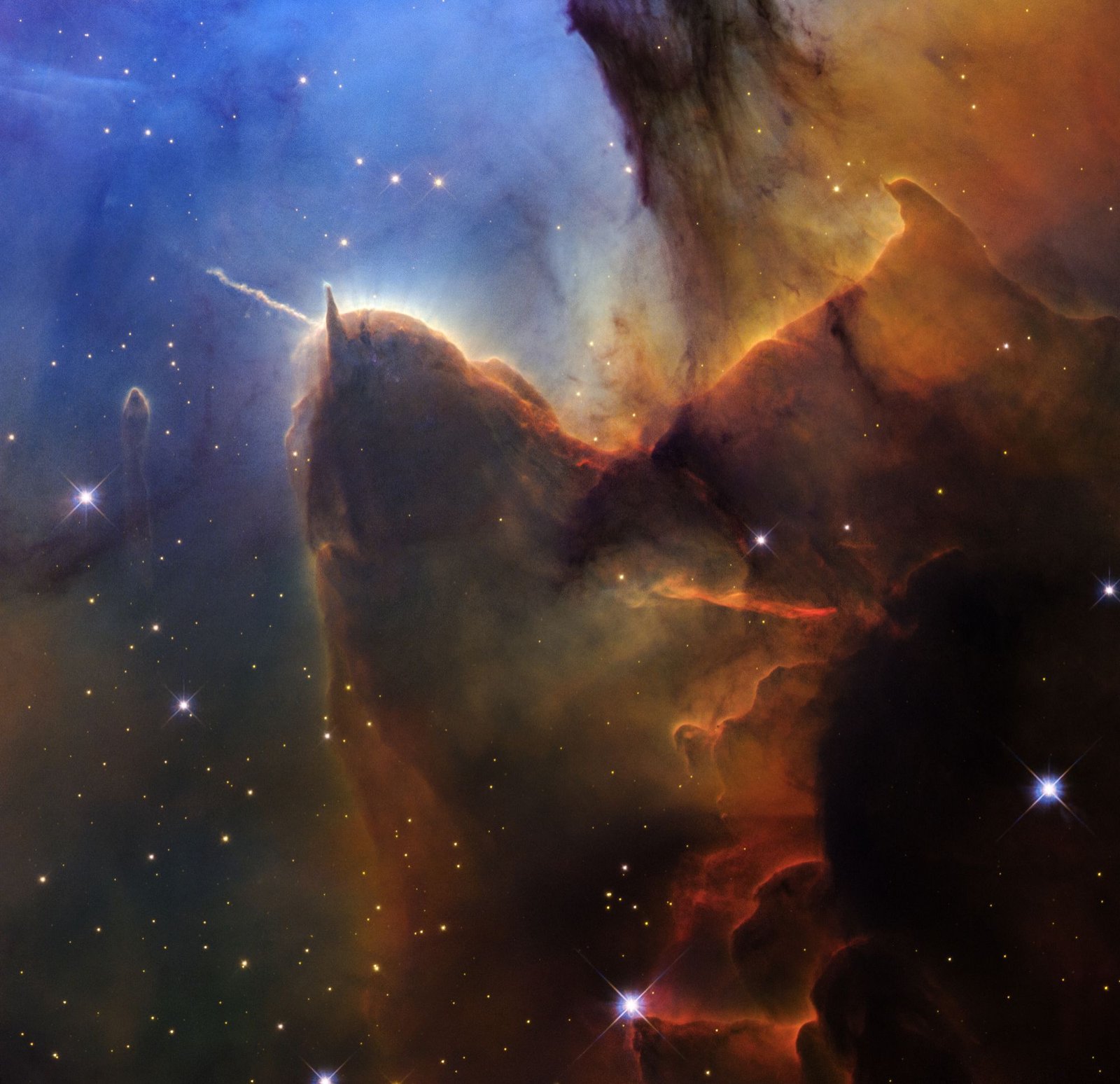
Credit: NASA, ESA, STScI
What They Are
The Trifid and Lagoon are two separate star-forming regions that happen to sit close enough together to share the same wide-field view. The Trifid Nebula (M20) gets its name from the dark dust lanes that appear to divide it into three lobes — a mix of glowing emission nebula, blue reflection nebula and the dark, obscuring dust that gives it its trisected look. The Lagoon Nebula (M8) is a larger, brighter emission nebula, its reddish glow powered by young, hot stars ionizing the surrounding hydrogen gas. Both are active stellar nurseries, actively forming new stars out of collapsing gas and dust.
Constellation & Distance
Both nebulae sit in Sagittarius, separated by only about 1.5 degrees on the sky — close enough to frame together in a single wide-field shot. The Trifid lies roughly 5,000 light-years from Earth, while the Lagoon sits somewhat closer, commonly cited around 4,000 to 4,100 light-years away.
Why It's Worth Seeing This Month
This pairing anchors this month's Best Deep Sky Targets list, with the best viewing window running July 10–18 around the New Moon on July 14. The Trifid is also the subject of this month's Image of the Month, following Hubble's 36th-anniversary revisit of the region — a coincidence of timing that makes July a particularly good month to seek it out yourself.
Equipment: Visual vs. Astrophotography
Visual: The Lagoon is the brighter and easier of the two, visible with the naked eye as a hazy patch under genuinely dark skies and an easy binocular target. The Trifid is noticeably fainter and smaller — a modest telescope helps reveal its dark dividing lanes, which are easy to miss in binoculars alone.
Astrophotography: A wide-field refractor captures both nebulae in a single frame, taking advantage of their close pairing. A dual-band Ha/OIII filter — the same type covered in our SVBONY SV220 filter review — helps pull the reddish emission glow out from background skyglow, particularly useful for imagers working under light-polluted skies.