
NGC 6946 "Fireworks Galaxy": A Spiral With a Supernova Habit
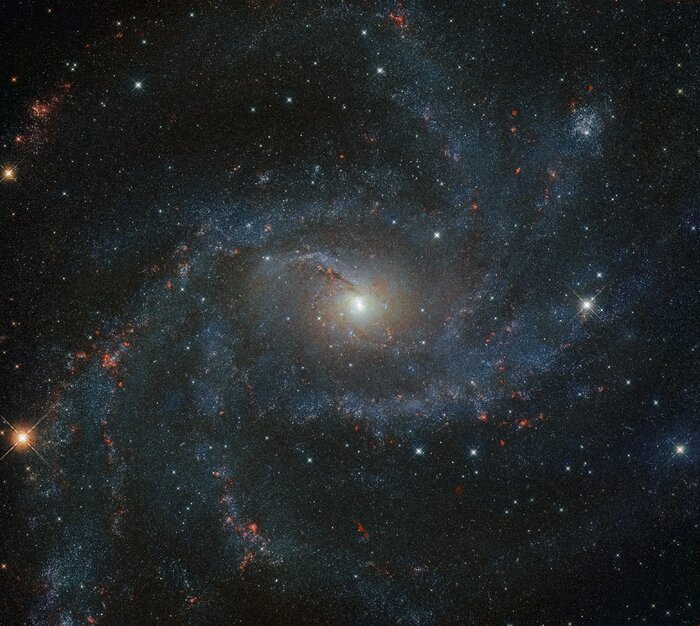
Credit: NASA/ESA Hubble
What It Is
NGC 6946 is a face-on spiral galaxy nicknamed the "Fireworks Galaxy" for an unusual distinction: ten supernovae have been observed within it over the past century, a strikingly high rate compared to roughly one or two per century typically observed in a galaxy like the Milky Way. Its high star-formation rate is the underlying reason — more massive young stars means more of them eventually go supernova.
Constellation & Distance
The galaxy straddles the border of Cepheus and Cygnus, and sits roughly 25.2 million light-years away — dramatically farther than every other object in this month's spotlight, since it's a separate galaxy rather than an object within our own.
Why It's Worth Seeing This Month
NGC 6946 stays well-placed in the evening sky through Northern Hemisphere summer alongside Cepheus and Cygnus. Because it's a genuinely distant, low surface brightness target, it's one of the better tests of how dark your observing site actually is — a useful benchmark object for gauging local sky conditions.
Equipment: Visual vs. Astrophotography
Visual: This is a demanding target. Under anything less than genuinely dark skies, it tends to appear as a faint, structureless smudge even through moderate aperture. A 10-inch or larger telescope under dark skies is where spiral structure starts to become plausible to detect visually.
Astrophotography: Dark skies matter as much for imaging as for visual observing — light pollution washes out the galaxy's low surface brightness before any amount of exposure time can fully compensate. A longer total integration time across multiple sessions, combined with a genuinely dark location, is what separates a flat smudge from a galaxy with visible spiral arms.