
Orionid Meteor Shower 2026: How to See Halley's Comet Light Up the October Sky
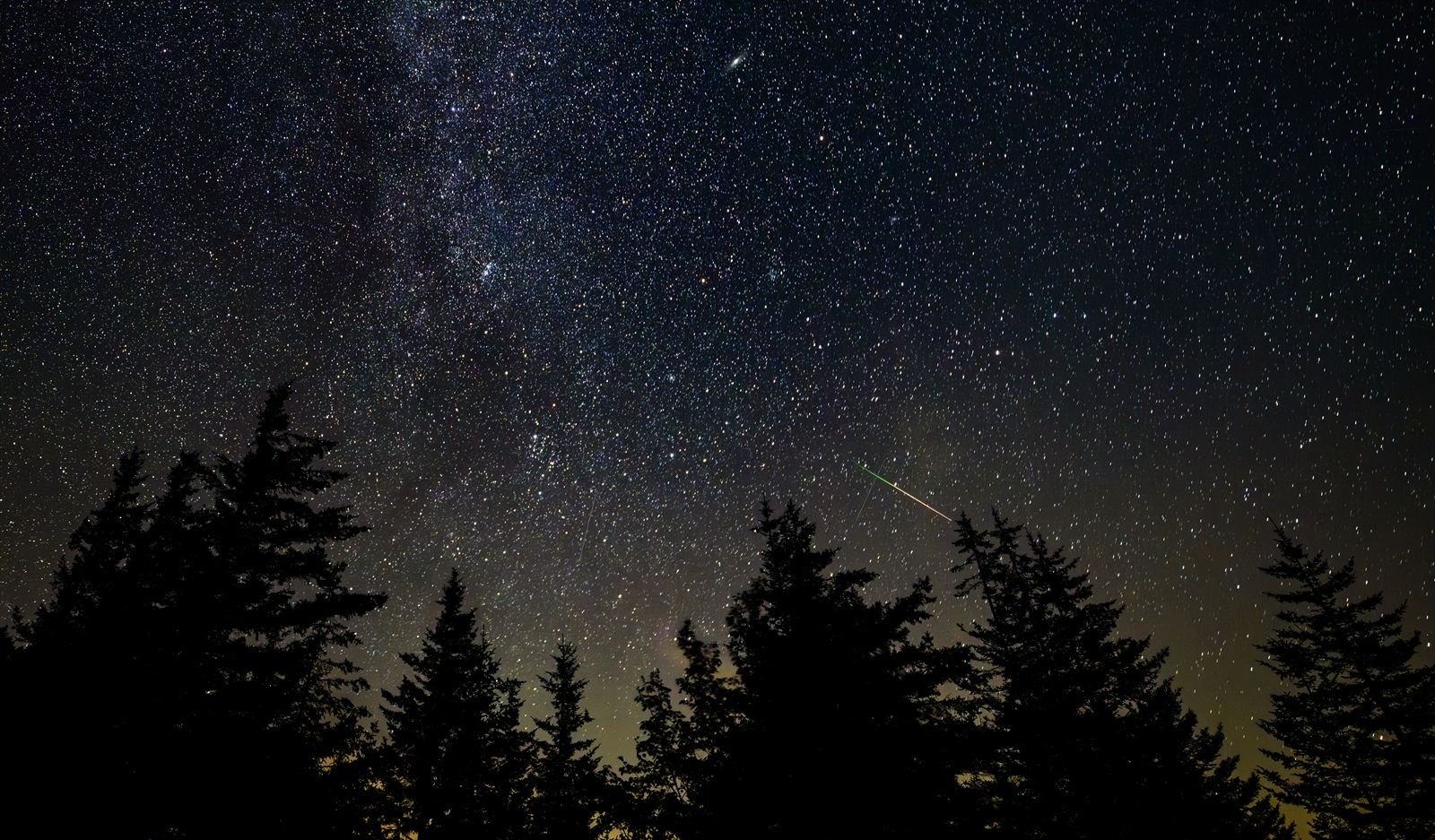
A 30-second exposure captures a meteor during the 2025 Perseid and Alpha Capricornids showers at Spruce Knob, West Virginia. It is not an Orionid, but it shows how a bright, fast meteor looks in a long exposure. Credit: NASA/Bill Ingalls
Every October, Earth passes through a stream of dust left behind by the most famous comet there is. The Orionid meteor shower is the result: not the busiest of the year, but fast, often bright, and easy to watch from either hemisphere with nothing more than your eyes. In 2026 it comes with a complication — a bright Moon — so this year the plan matters more than the peak date.
What Are the Orionids?
The Orionids are an annual meteor shower made of tiny pieces of debris shed by comet 1P/Halley. When one of those grains hits Earth's atmosphere at high speed it burns up, and the streak of light it makes is a meteor. The shower is named for Orion because the meteors appear to radiate from that part of the sky, a point called the radiant. Orion is only the direction they seem to come from; the constellation has nothing to do with where they originate.
They are fast. NASA puts their speed at about 66 kilometers (41 miles) per second as they enter the atmosphere, and describes Orionid meteors as known for both their speed and their brightness. Fast meteors can leave glowing "trains" behind them and can sometimes flare into fireballs. Those are the exceptions rather than something to count on, but they are why a modest shower can still deliver a few memorable moments.
Halley's Comet and the Orionids
Halley's Comet returns to the inner solar system about every 76 years. It last passed closest to the Sun on February 9, 1986, and it is not due back until 2061. You will not see the comet itself this October: what lights up the sky is the debris it has shed along its orbit.
Earth crosses that debris trail twice a year, which is why one comet is behind two showers — the Orionids in October and the Eta Aquariids in May. The link between comets and their returns goes back to 1705, when Edmond Halley used Newton's theories to show that bright comets seen in 1531, 1607 and 1682 were a single object, and predicted it would come back in 1758. It was the first such prediction ever made.
Orionids 2026 at a glance
- Active: October 2 to November 7, 2026
- Peak night: October 21 to 22
- NASA's dark-sky rate: about 10 to 20 meteors per hour
- Speed: about 66 km/s (41 mi/s)
- Parent comet: 1P/Halley
- Radiant: just north of Betelgeuse, in Orion
- Equipment: none; visible from both hemispheres
The Moon Will Cost You Meteors This Year
The 10 to 20 meteors per hour figure is NASA's estimate for dark skies, and it is best read as a ceiling for a good night rather than a promise. What you actually count depends on how dark your site is, how clear the sky is and how much of it you can see, and in 2026 the Moon makes the sky less dark than it should be at this time of year. NASA notes that a bright waxing gibbous Moon will wash out some of the fainter meteors. The brighter Orionids will still show up, but the faint ones that make up much of any shower's tally will be harder to notice. Expect fewer than the theoretical maximum, and do not be surprised by long gaps between meteors. Nobody can honestly guarantee a number for your sky, and this guide will not try.
The better news is that this is a waxing Moon, so it sets before the sky starts to brighten for the morning. NASA's advice is to look in the few hours before dawn, after the Moon has set. The exact time depends on where you are and NASA does not give a clock time, so check the moonset time for your location that night. Until then, keep the Moon behind you or hidden behind a tree or building, and face the darkest part of the sky. Sightline shows the Moon's phase next to the sky conditions for the place you choose, which makes it a quick check before you head out.
Where and When to Look
The Orionids are active from October 2 to November 7, and the peak night is October 21 to 22. NASA suggests watching after midnight, away from city and street lights; the shower continues until dawn. Meteor showers build and fade gradually, so nearby nights can also show some Orionids, usually fewer.
You do not need a telescope or binoculars, and you do not need to be in a particular hemisphere. NASA recommends lying flat on your back with your feet pointing southeast if you are in the Northern Hemisphere, or northeast if you are in the Southern Hemisphere. Binoculars and telescopes only show a small patch of sky, while meteors can streak across any part of it.
The radiant sits just north of Betelgeuse, the bright red star of Orion, which is climbing the eastern sky in the hours after midnight. You do not have to stare at it. NASA advises looking 45 to 90 degrees away from the radiant: meteors seen there have longer trails, while those that point straight at the radiant look short because of perspective.
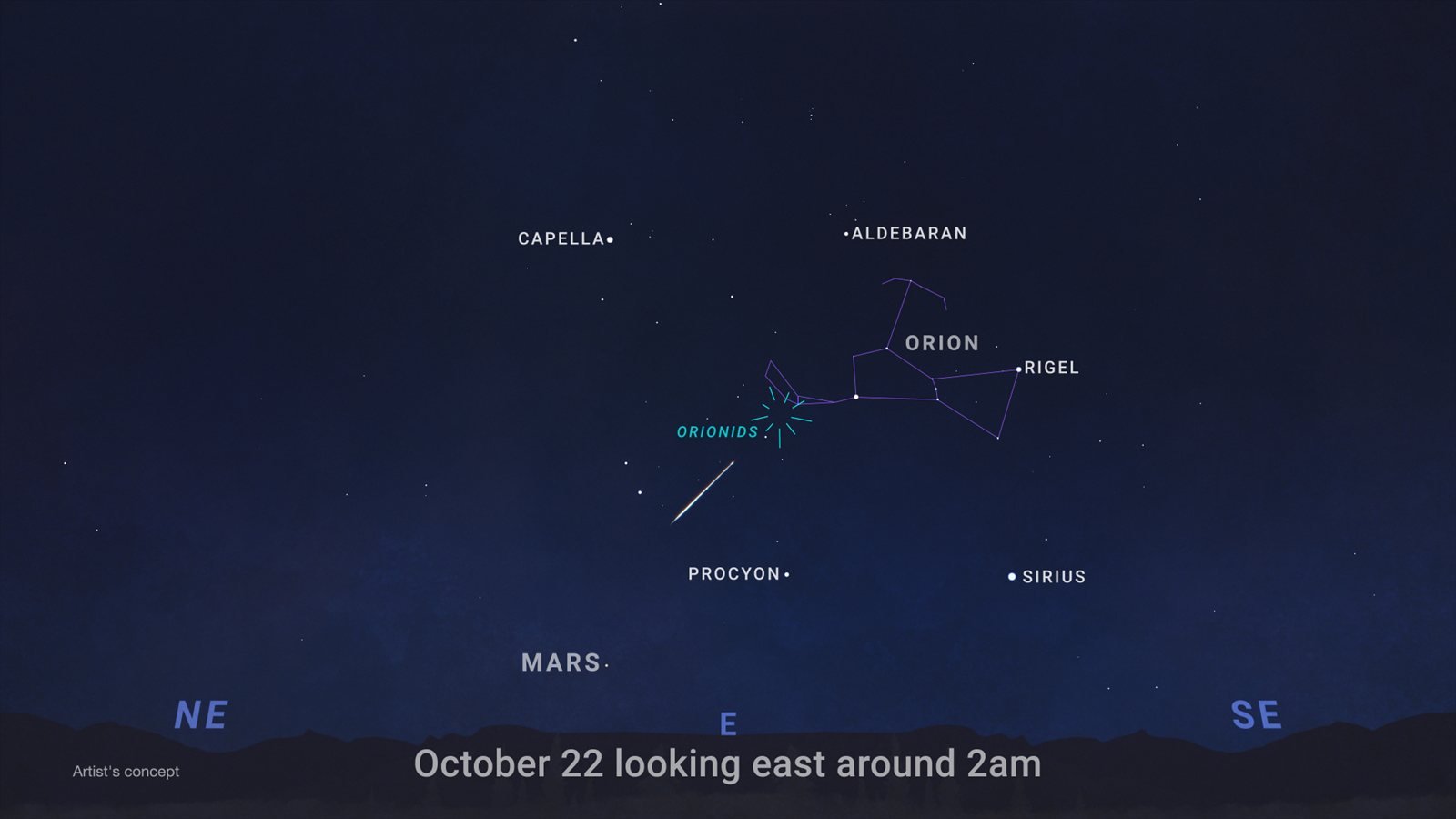
The eastern sky around 2 a.m. on October 22, with Orion and the Orionid radiant. NASA labels the chart an artist's concept. Credit: NASA/JPL-Caltech
How to Watch: Practical Tips
- Get away from lights. A dark site matters more than anything else you can do, and more so with a bright Moon in the sky. Our guide to the Bortle scale and light pollution explains how to judge a site.
- Give your eyes time. NASA suggests about 30 minutes to adjust to the dark. Keep phone screens dim or use a red light.
- Lie back and look wide. A reclining chair or a mat works well. Take in as much sky as you can instead of fixing on one spot.
- Dress warmly. You will be still for a long time in the cold hours before dawn. Bring a blanket and warm layers.
- Check the clouds and the Moon. A clear sky helps more than a few extra degrees of altitude.
- Be patient. Even at 10 to 20 meteors per hour you would wait a few minutes between meteors on average, and with the Moon in 2026 gaps will be longer.
How to Photograph the Orionids
You cannot aim at a meteor, because they appear at random times and places. The strategy is to cover as much sky as possible and keep shooting. Fast, bright meteors like the Orionids reward patience.
- Use a wide-angle lens. It covers more sky and improves your odds. Telephoto lenses cover only a small patch.
- Use a sturdy tripod and a remote release or self-timer so pressing the shutter does not shake the camera.
- Focus on a star. NASA recommends starting at infinity, then taking short test shots and zooming in on a star until it is sharp.
- Start with the 500 Rule. NASA's starting point for the longest exposure is 500 divided by your focal length in millimeters, so a 20 mm lens gives about 25 seconds. High-resolution sensors can show star trails sooner; our Milky Way without a tracker guide explains why and what to use instead.
- Check the Moon. A bright Moon lifts the background of the sky, so you may need shorter exposures or a lower ISO than on a moonless night. Frame away from the Moon.
- Protect your night vision. NASA suggests dimming the camera's LCD. Then keep the shutter going and review the frames later: only a fraction of them will catch a meteor.
For a real-world reference, the photograph at the top of this page was taken by NASA's Bill Ingalls with a Nikon Z 9 and a 14 mm lens at f/2.8, ISO 800, for 30 seconds, according to the file's embedded metadata. If you are starting from scratch, our Orion Nebula guide is a good companion for the constellation that gives the shower its name.
Sources and Image Credits
Dates, rates, speed, radiant and viewing advice come from NASA: the Orionids page, What's Up: October 2026, How to Photograph a Meteor Shower and 1P/Halley. Meteor counts and the Moon's effect can differ from what you see on the night.
Images: meteor photograph by NASA/Bill Ingalls (NASA Image and Video Library, NHQ202508030001); sky chart by NASA/JPL-Caltech, from NASA's What's Up: October 2026. Both are used with credit under NASA's media usage guidelines. ORIVON only resized them.
Frequently Asked Questions
The Orionids are active from October 2 to November 7, 2026, and NASA lists the peak as the night of October 21 to 22. The best viewing is in the hours after midnight and before dawn.
Under dark skies NASA puts the Orionids at about 10 to 20 meteors per hour, but that is a best-case figure. In 2026 a bright waxing gibbous Moon will wash out some of the fainter meteors, so most observers should expect fewer, and no count can be guaranteed.
No. The Orionids are a naked-eye event, visible from both the Northern and Southern Hemispheres. Binoculars and telescopes show only a small patch of sky, while meteors can appear anywhere.
No. Halley's Comet last passed the Sun in 1986 and is not due back until 2061. The Orionids are made of debris it left behind, which burns up in Earth's atmosphere as meteors.