What Would You See If You Fell Into a Black Hole?
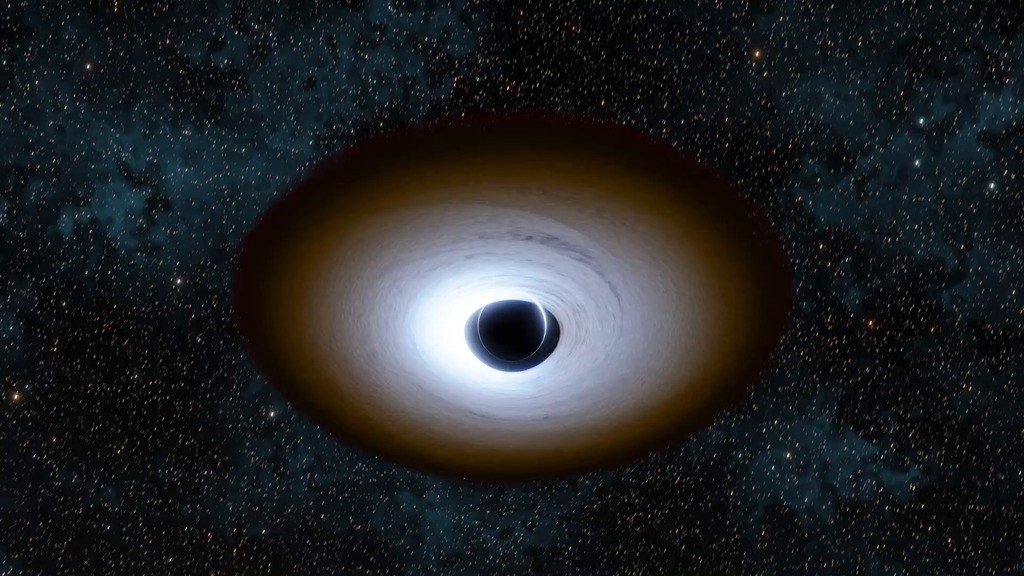
Scientific visualization of a black hole surrounded by an accretion disk. This is a simulation, not a photograph. Credit: NASA/JPL-Caltech/R. Hurt (IPAC).
Let's set up a specific, honest scenario, because the answer to "what would you see" depends heavily on which black hole you mean. Take a single, isolated, non-rotating black hole with no accretion disk, no companion star, and no other matter actively falling in nearby — the simplest case general relativity describes, sometimes called a Schwarzschild black hole. No telescope has ever directly photographed the experience of falling into one, and none ever will, for a reason that will become clear by the end of this article. What follows is what the physics actually predicts for that scenario, what changes if you add real-world matter and light around the black hole, and — just as important — what remains genuinely unknown rather than settled.
How Gravitational Lensing Would Reshape the Sky Around You
As you approached the black hole, its gravity would bend the path of light passing near it — a real, measured effect called gravitational lensing, first confirmed during a 1919 solar eclipse observation and now used routinely by astronomers to study distant galaxies. Falling closer, this effect would become extreme: light from stars and galaxies behind the black hole, from your perspective, would bend around it and appear smeared into rings and multiple distorted images encircling the black area at the center of your view. The sky wouldn't simply go dark in one direction — it would appear to wrap and compress around an expanding black disc directly ahead of you.
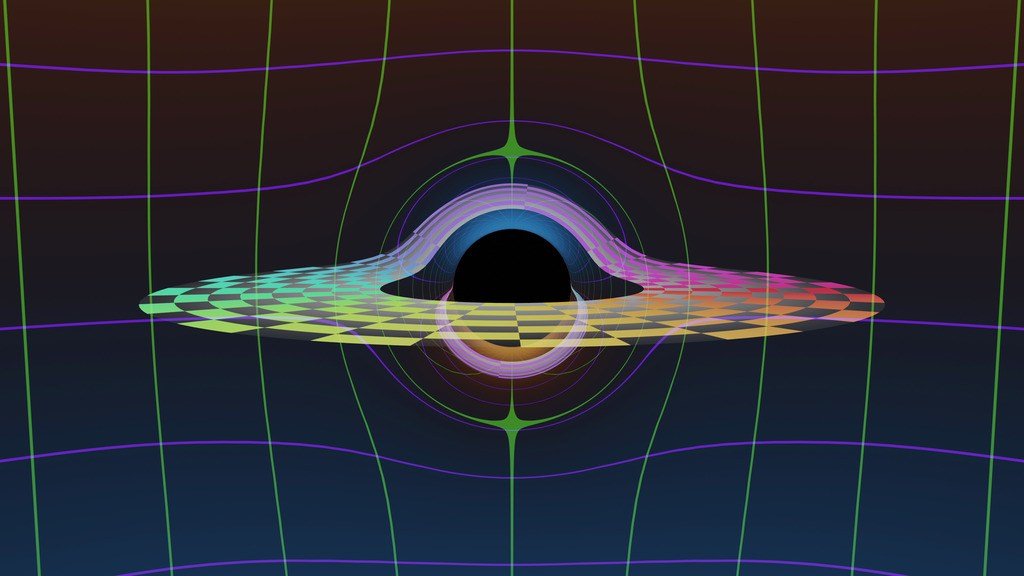
A color-coded visualization shows how a black hole bends light from its surroundings. The grid and colors are explanatory aids, not physical structures. Credit: NASA/JPL-Caltech/R. Hurt (IPAC).
Accretion Disk, Shadow and Event Horizon: Three Different Things
These three terms get used almost interchangeably in casual conversation, but they describe genuinely different things. The event horizon is the boundary itself — the point of no return, defined mathematically by the black hole's mass, past which nothing, not even light, can escape back outward. The shadow is the dark, roughly circular region an outside observer sees silhouetted against a bright backdrop — slightly larger than the event horizon itself, because light passing near (but not quite through) the horizon still gets bent enough to disappear from view, effectively enlarging the dark region as seen from outside. The accretion disk is something else again: a swirling disk of gas and dust, heated to extreme temperatures by friction and gravity as it spirals inward, which is what actually produces the light that makes real black holes detectable at all — a black hole with genuinely nothing around it emits no light of its own and would be effectively invisible except for its gravitational and lensing effects on background light.
Two Perspectives, Two Very Different Experiences
This is the single most important idea in this article: what you would experience falling in, and what somebody watching from a safe distance would see happen to you, are not the same story — and conflating them is where most popular misconceptions about black holes come from.
Your own experience, falling in: for a sufficiently large (supermassive) black hole with gentle tidal forces at the horizon, crossing the event horizon itself would not necessarily feel like a distinct, dramatic event in the moment — it's a boundary defined by extreme gravity's effect on light and spacetime, not a physical wall or membrane you'd feel yourself pass through. From your own perspective, in your own limited, finite time, you would continue falling — toward increasingly extreme tidal stretching, and eventually toward the singularity, where general relativity's equations stop producing meaningful predictions at all.
A distant observer's experience, watching you fall: to someone watching from far away, you would never appear to actually cross the horizon at all. Due to gravitational time dilation, your clock would appear to run increasingly slowly compared to theirs as you approached the boundary, and your image would appear to slow down and hang almost motionless just outside it. This is genuinely how NASA describes its own black hole visualization: from outside, "the image of the camera would slow and then seem to freeze just shy of" the horizon.
Why "Frozen Forever" Isn't Quite the Full Picture
This is a common and understandable point of confusion, worth addressing directly: the idea that a distant observer would see you frozen at the horizon forever, as a literally permanent, brightly visible image. In the strict mathematics of an idealized, unchanging black hole, your image does approach the horizon asymptotically in the distant observer's own measured time, meaning it never mathematically reaches a defined "final moment." But that isn't the same as remaining bright and visible forever in any practical sense. Alongside the slowing effect, your light also becomes progressively more redshifted and dramatically dimmer — the two effects compound together extremely quickly. In practice, the light you emit while crossing the horizon redshifts and fades below any realistic threshold of detectability in a small fraction of a second to at most a few seconds of the distant observer's time, depending on the black hole's mass, not over years or millennia. A real observer's telescope would see you fade to complete invisibility almost immediately, not maintain a frozen, visible portrait indefinitely.
The Event Horizon Isn't a Solid Surface
It's worth restating this plainly because it undercuts a lot of black hole fiction: the event horizon has no physical substance. There's no wall, no membrane, no barrier you would bump into or feel yourself pass through at a specific instant. It's a boundary in the geometry of spacetime itself, defined by the point past which even light aimed straight outward can no longer escape the black hole's gravity. For a sufficiently large black hole, the local conditions of space and gravity right at that boundary can be comparatively unremarkable — the boundary's significance is entirely about what happens afterward (nothing can get back out), not about a dramatic local sensation at the moment of crossing it.
Tidal Forces and Spaghettification
Gravity's strength drops off sharply with distance, which means, for an object falling feet-first toward a black hole, the pull on the feet (closer to the black hole) can become measurably stronger than the pull on the head (farther away). That difference in force across the length of your body is a tidal force, and if it becomes extreme enough, it stretches an infalling object along its length while compressing it from the sides — the process popularly nicknamed "spaghettification."
How extreme this gets, and where it happens, depends enormously on the black hole's size — which leads directly to one of the most counterintuitive facts in this entire topic.
Stellar-Mass vs. Supermassive: A Genuinely Different Experience
For a stellar-mass black hole — one formed from the collapse of a massive star, typically a few to a few dozen times the Sun's mass — tidal forces near the event horizon are so extreme that an infalling object would likely be spaghettified well before it even reaches the horizon itself. This isn't just theoretical: astronomers have observed real stars being tidally disrupted and stretched by black holes in deep space, direct observational evidence that this process genuinely happens.
For a supermassive black hole — millions or billions of times the Sun's mass, like the one at the center of our own Milky Way — the situation is strikingly different. Because a supermassive black hole's event horizon sits much farther from its central singularity relative to its own size, the difference in gravitational pull across the length of a human body at the horizon itself can be comparatively tiny. NASA's own black hole visualization work notes that for the Milky Way's central supermassive black hole (roughly 4.3 million times the Sun's mass), the head-to-foot gravity difference at its event horizon is only about 0.02% — genuinely survivable, moment to moment, at least at that specific point. The violent, fatal tidal stretching would still happen eventually, deeper inside, as the infalling object approaches the singularity itself — just not immediately at the horizon, the way it would for a small black hole.
What a Real Accretion Environment Changes
Strip away the idealized, isolated scenario this article started with, and reality gets considerably more hostile. Most black holes astronomers actually observe have some amount of surrounding matter — a companion star's stripped-off gas, or a disk of infalling material — and that changes the experience dramatically. An active accretion disk means intense radiation, extreme temperatures, and matter moving at a meaningful fraction of the speed of light in your immediate vicinity well before you'd reach the horizon at all. Realistically, in most real astrophysical environments, radiation and violent collisions with infalling matter would pose a serious threat long before the more exotic, purely gravitational effects described above became the primary concern.
What General Relativity Actually Describes — and Where It Stops
Everything above — lensing, horizons, time dilation, tidal forces — comes from general relativity, Einstein's theory of gravity, which has been tested and confirmed to extraordinary precision across a century of observation, including the direct imaging of black hole shadows and the detection of gravitational waves from merging black holes. But general relativity's own equations predict something it cannot itself fully explain: a singularity, a point of theoretically infinite density at a black hole's center, where the theory's predictions become meaningless rather than merely difficult. Most physicists take this as a sign that general relativity alone is incomplete at the most extreme scales, and that a full theory of quantum gravity — successfully merging general relativity with quantum mechanics, something physicists have not yet achieved — would be needed to actually describe what happens at a singularity, or arguably whether "inside a black hole" is even a fully meaningful phrase in the way we'd naturally imagine it.
What We Should Not Present as Observed Fact
Because this topic invites vivid imagery, it's worth being explicit about what current science does not support presenting as established fact: there is no confirmed singularity, wormhole, portal, tunnel, or passage to another universe or another point in time that has ever been observed or verified — these remain, at most, speculative mathematical extensions explored by some theoretical physicists, not confirmed physics, and popular science-fiction depictions routinely present them with far more confidence than the underlying physics actually supports. Likewise, no one has observed, or could observe, the actual interior of a black hole and report back — every description of "the inside" beyond the horizon is a theoretical extrapolation from equations that we know break down before they can fully answer the question.
Sightline and Watching Black Hole-Adjacent Objects Yourself
You can't observe a black hole directly with a backyard telescope — by definition, it emits no light of its own — but several of the deep-sky objects on any given night are the visible remnants or companions of extreme stellar physics worth understanding in this same context. ORIVON Sightline can help you plan an observing session around what's actually visible tonight from your location, while guides like ORIVON's galaxies, nebulae and clusters explainer cover the kinds of objects you can genuinely point a telescope at.
Frequently Asked Questions
No — this is a popular myth. It would take an infinite amount of outside time for you to reach the horizon as measured from far away, which is sometimes mistaken for meaning you'd witness all of cosmic history first. In your own experience, falling in happens in a finite, often short amount of your own time, and you would not watch the universe's entire future play out.
Not according to general relativity, for a non-rotating black hole with nothing else going on. Once you cross the horizon, every possible direction of travel leads further inward, toward the singularity — it stops being a question of powerful enough engines and becomes a statement about the geometry of space and time themselves.
No. The event horizon is a boundary defined by extreme gravity, not a physical wall, membrane or surface. Falling through it, you wouldn't necessarily feel a distinct physical sensation at that exact moment — especially for a very large black hole, where local conditions right at the horizon can be comparatively mild.
No, and the difference is dramatic. For a stellar-mass black hole, tidal forces are so extreme that you would likely be stretched apart (spaghettified) before ever reaching the event horizon. For a supermassive black hole, tidal forces at the horizon can be comparatively gentle — NASA notes the head-to-foot gravity difference at the horizon of the Milky Way's own supermassive black hole is only about 0.02%, meaning you could plausibly cross the horizon itself without being torn apart immediately.
No, and it's important to be honest about that. General relativity's equations predict a singularity — a point where the theory itself stops giving meaningful answers — but no one has directly observed the interior of a black hole, and no experiment can. Popular depictions of tunnels, portals or passages to other universes are speculative extensions of the mathematics, not observed or confirmed physics.
Sources & Methodology
The core scenario, the distinction between an infalling observer's experience and a distant observer's, the "slow and seem to freeze" description, and the specific supermassive-black-hole tidal-force figure (0.02% at the horizon of a 4.3-million-solar-mass black hole) are drawn from NASA Goddard Space Flight Center's 2024 black hole visualization, created by astrophysicist Jeremy Schnittman with Brian Powell (science.nasa.gov). The observed disruption of real stars by black hole tidal forces reflects published astronomical observations of tidal disruption events. General-relativity concepts (event horizon, gravitational lensing, time dilation, the incompleteness of the theory at a singularity) reflect the standard, well-established framework of the theory as confirmed by decades of observational tests, including gravitational-wave detections and direct black hole shadow imaging. This article does not present speculative interior physics, wormholes or multiverse scenarios as confirmed science, and none of its scientific claims are ORIVON's own novel research.