DWARF 3 vs DWARF Mini: Which Smart Telescope Should You Buy?
This article contains affiliate links. If you buy through them, ORIVON may earn a commission at no extra cost to you. Our editorial conclusions don't depend on those links.
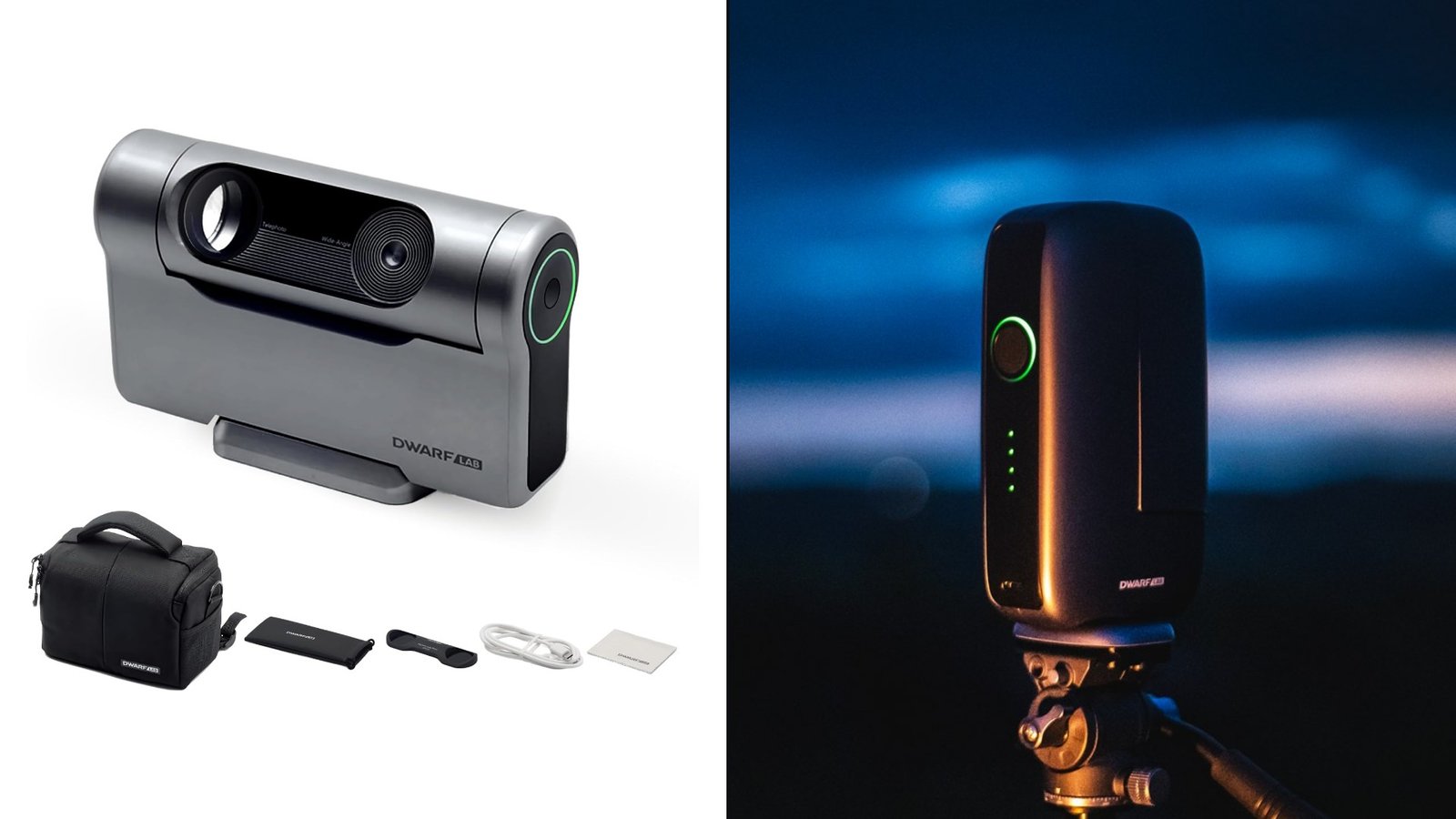
Credit: DWARFLAB
The DWARF 3 and the DWARF Mini come from the same company and share the same basic idea: a compact, motorized telescope you control from your phone, with no eyepiece and very little setup beyond finding a tripod. They are built for different buyers, though. The Mini is the smaller, lighter and less expensive of the two. The DWARF 3 has a larger aperture and a higher-resolution sensor, and it costs more.
This comparison looks at what those differences mean once you're actually outside with the telescope, so you can decide which trade-offs you're comfortable with. Neither one is the better telescope in every situation, and we don't pretend otherwise.
Specifications were checked against DWARFLAB's official product pages and help center on October 5, 2026. ORIVON hasn't tested the two telescopes side by side; this comparison draws on those official specifications and on the research behind our full DWARF 3 and DWARF Mini reviews.
Quick Verdict
There isn't a universal winner here. The DWARF Mini is the more sensible choice if you want the lowest price, the lightest body and the simplest way to start with automated astrophotography. The DWARF 3 is the better choice if you're willing to pay more and carry a little more for a larger aperture, a 4K-class sensor and more room to grow.
In short: the Mini optimizes for portability and cost, the DWARF 3 for image capability.
Save 5% on either telescope.
Use code ORIVON at the official DWARFLAB store.
Discount eligibility confirmed by DWARFLAB.
Which One Fits You?
Choose the DWARF Mini if…
- You want the lower price of the two and the smallest body (840 g)
- You plan to carry it often: travel, hiking, a daypack or a carry-on
- You're new to astrophotography and mostly want to find out whether you enjoy it
- You'll mainly view and share results on a phone, where about 2 MP is enough
- You'd rather keep your spending low until you know how much you'll use it
Choose the DWARF 3 if…
- You want more detail and more room to crop from a 4K-class (3840 × 2160) sensor
- A 35 mm aperture matters more to you than saving weight
- You expect to image faint deep-sky targets regularly and want more light per minute
- You like having 128 GB of built-in storage and a larger battery for long sessions
- You'd rather buy once than outgrow a smaller sensor
DWARF 3 vs DWARF Mini at a Glance
| Feature | DWARF 3 | DWARF Mini |
|---|---|---|
| Telephoto apertureMore aperture collects more light in the same time. | 35 mm Edge | 30 mm |
| SensorA larger sensor with more pixels offers a wider frame and more detail. | Sony IMX678 (Starvis 2), 1/1.8-inch Edge | Sony IMX662, 1/2.8-inch |
| Image resolutionMatters for cropping, large screens and prints. | 3840 × 2160 (8.3 MP) Edge | About 2 MP |
| Wide-angle cameraHandy for framing, daytime shots and wide scenes. | Yes (2 MP) | Yes (fixed focal length) |
| WeightDecides how easily it travels. | About 1.3 kg | 840 g Edge |
| BatterySets how long a session can run. | 10,000 mAh; up to about 5.5 h of astro use Edge | 7,000 mAh; about 4 h rated |
| Built-in storageRoom for photos and video before you offload them. | 128 GB Edge | 64 GB |
| Longest exposure in EQ modeLonger frames can help on dark, faint targets, though stacking matters more. | 60 s (currently) | 90 s Edge |
| Built-in filtersBoth include a dual-band option aimed at nebulae under bright skies. | VIS, Astro and dual-band modes | Dark-frame, astro (430–690 nm) and dual narrowband |
| Tripod in the box | No | No |
| Upfront costPrices change, so check current listings. | Higher | Lower Edge |
We don't quote prices here because they change often. Sources are listed at the end of the article.
Save 5% on either telescope.
Use code ORIVON at the official DWARFLAB store.
Prices change, so confirm the current price at the store before you buy.
Image Quality
In a smart telescope, image quality comes from three things working together: how much light the lens collects, how the sensor records it, and how many frames the software can stack. Both telescopes handle the stacking for you, so the DWARF 3's advantage comes from better inputs rather than a different workflow.
On paper, the DWARF 3 starts from a stronger place: a bigger lens, a larger sensor and a higher-resolution image. That should show up as more room to crop, a little more fine structure in smaller targets, and a cleaner result from a given amount of observing time. It doesn't turn either telescope into an observatory-class instrument. Both are small-aperture refractors, and seeing conditions, tracking and the time you spend on a target will matter as much as the spec sheet.
The Mini is best judged against what it's for. A roughly 2-megapixel image is perfectly good for sharing on a phone and for learning how stacking works. It becomes the limiting factor when you want to crop hard, view on a large screen or print.
Sensor and Resolution
The DWARF Mini uses a Sony IMX662 sensor, a 1/2.8-inch format with 2.9 µm pixels, and DWARFLAB describes it as supporting 2-megapixel RAW shooting. The DWARF 3's telephoto camera uses a Sony IMX678 (Starvis 2), a 1/1.8-inch format that DWARFLAB lists at 8.3 megapixels, with telephoto pictures at 3840 × 2160.
That's roughly four times as many pixels in the DWARF 3's frame. More pixels only turn into more visible detail if the optics, focus and sky can deliver it, and a 35 mm refractor has its limits. But a larger, higher-resolution frame gives you more to work with when you crop a small galaxy or nebula, and it holds up better on a big monitor.
The Mini's pixels are relatively large, which helps each one collect more light, but there are far fewer of them, so total detail has a hard ceiling. DWARFLAB doesn't publish the DWARF 3's pixel size on the pages we checked, so we won't compare pixel sizes directly. Both telescopes also carry a wide-angle camera, which is more useful for framing and wide scenes than for deep-sky detail.
Aperture and Light Gathering
The DWARF 3's telephoto lens has a 35 mm aperture; the Mini's is 30 mm. Light-gathering area scales with the square of the diameter, so (35 ÷ 30)² is about 1.36: the DWARF 3 collects roughly 36% more light. If everything else were equal, a target would reach the same signal in about three-quarters of the time.
Everything else isn't equal, of course. The sensors, optics and conditions differ, so treat that figure as a rough guide rather than a promise. A 5 mm difference is useful but not dramatic. It's most noticeable on faint targets and least noticeable on bright ones like the Moon or a large open cluster. With its 150 mm focal length, the DWARF 3 works at roughly f/4.3, a figure we calculated from DWARFLAB's numbers.
Portability and Setup
This is where the Mini earns its place. At 840 g it's roughly 460 g lighter than the DWARF 3's approximately 1.3 kg, and it's small enough to travel almost anywhere. If you fly with hand luggage or hike to your observing spot, that difference is easy to feel. If you drive to a dark site, it matters much less.
Neither telescope comes with a tripod, so budget for one. The DWARF 3's box includes a carrying bag, which is handy for protecting it in transit. Day to day, both are controlled through DWARFLAB's app: mount the telescope, power it on, connect your phone and choose a target. The setup is broadly similar, so portability is the real difference rather than complexity.
Storage, Battery and Everyday Use
The DWARF 3 has 128 GB of built-in storage against the Mini's 64 GB, and a 10,000 mAh battery against 7,000 mAh. DWARFLAB reports measured astro-mode runtimes of up to about 5.5 hours for the DWARF 3 and rates the Mini at about four hours. Real runtimes depend on temperature, the mode you're in and how you use the telescope.
For a weekend of casual observing, both are comfortable. The extra storage and battery matter if you shoot long sessions, record video or time-lapses, or don't want to offload files every night. The DWARF 3 also carries an IP54 rating according to DWARFLAB, meaning protection against dust and splashes, which is reassuring on a damp night, although it isn't a waterproof telescope.
One specification runs the other way: DWARFLAB lists a maximum exposure of 90 seconds in EQ mode for the Mini and, currently, 60 seconds for the DWARF 3. Longer individual frames can help on dark, faint targets, but total integration time usually matters more than frame length, so we wouldn't base the decision on it.
Performance Under Light Pollution
Both telescopes include built-in filters aimed at brighter skies, including a dual-band option that helps emission nebulae stand out against sky glow. Neither can remove light pollution, and neither one changes the basic rule: bright skies reward bright, high-contrast targets such as the Moon, star clusters and emission nebulae, and punish faint galaxies.
The DWARF 3's larger aperture can shorten the time you need for a good result, but it doesn't change what's realistic from a very bright sky. For a closer look at what works from the city, see our guide to the best smart telescopes for city skies, and our explainer on the Bortle scale if you're not sure how dark your own sky is. Both telescopes are also light enough that driving to a darker site is a realistic option, which is often the biggest upgrade you can make. Our light pollution guide covers that in more detail.
Ease of Use for Beginners
Both telescopes give you the same basic workflow: pick a target in the app and let the telescope handle alignment and tracking. Neither should be hard to use. A beginner's real learning curve is the app, finding dark skies and being patient with stacking, not the hardware.
The difference is the cost of changing your mind. The Mini's lower price makes it a smaller commitment if you try astrophotography and find it isn't for you. The DWARF 3 asks for more upfront, but it gives you more room to grow if you're already sure you'll keep going. If you're unsure, the Mini is the lower-risk first step; if you're certain, a beginner can start on the DWARF 3 without any extra difficulty.
Who Should Buy the DWARF Mini?
The Mini suits people who value size and cost above all else: travelers, hikers, apartment dwellers with little storage space, and first-time buyers who want to test the hobby before spending more. It's a good fit if you mostly view results on a phone and care more about getting out often than about squeezing out every bit of detail.
It's a weaker fit if you already know you want to crop deeply, print large or work on faint, small targets. In that case, the sensor and aperture limits will show up sooner than you'd like. Read the full DWARF Mini review for a closer look at its strengths and limits.
Who Should Buy the DWARF 3?
The DWARF 3 suits people who care about image capability and long-term headroom: those who want a larger frame, more light and more storage, and who don't mind carrying about half a kilogram more. It's a sensible pick if astrophotography is likely to become a regular hobby rather than an experiment.
It's a weaker fit if portability or price is your deciding constraint, since that's exactly where the Mini is stronger. Read the full DWARF 3 review for a closer look at how it compares with other smart telescopes.
Final Verdict
Choose by constraint. If weight or budget is the constraint that actually binds, the Mini removes it. If image size and light-gathering are what bother you, the DWARF 3 addresses them. Few buyers stay torn once they know which of those two matters more.
Neither telescope is a mistake. The Mini gives up some aperture and resolution in exchange for being easier to carry and easier to afford; the DWARF 3 asks for a higher price and a heavier bag in exchange for a stronger sensor and more capacity. Both rely on the same app-driven approach, so the decision comes down to what you want to do with the telescope and how far you expect to push it.
Save 5% on either telescope.
Use code ORIVON at the official DWARFLAB store.
Either telescope is a reasonable buy for the right person. Discount eligibility confirmed by DWARFLAB.
Frequently Asked Questions
Is the DWARF 3 better than the DWARF Mini?
In several specifications, yes: it has a larger 35 mm aperture, a higher-resolution sensor, more storage and a bigger battery. It's also heavier and costs more, and the Mini's lower weight and price are real advantages. Which one is better depends on what you value most.
How much bigger is the DWARF 3's aperture?
The DWARF 3's telephoto lens has a 35 mm aperture, while the DWARF Mini's is 30 mm. Because light collection scales with aperture area, that's roughly 36% more light-gathering area, which is a useful difference but not a dramatic one.
Is the DWARF Mini good enough for beginners?
Yes. It uses the same automated, app-controlled approach as the DWARF 3, and its lower price makes it an easier first purchase. Its roughly 2 MP sensor limits cropping and fine detail, so it's best seen as a low-cost, portable way to find out whether you enjoy the hobby.
Do I need to buy a tripod for either telescope?
Neither telescope includes a tripod, so you'll need to buy one separately before you can use either of them outdoors. DWARFLAB sells its own, and you should budget for that alongside the telescope.
Which one works better under light pollution?
Both include built-in filters aimed at brighter skies, including a dual-band option for emission nebulae. The DWARF 3's larger aperture can shorten the time needed for a good result, but neither telescope can overcome a very bright sky when it comes to faint galaxies.
Read the Full Reviews
For a deeper look at each telescope on its own, read our complete DWARF 3 review and DWARF Mini review. If you're still weighing other brands, our best smart telescopes guide ranks the current options by budget, portability and city-sky use.
Sources and Methodology
Specifications come from DWARFLAB's own documentation, checked on October 5, 2026:
- DWARF 3 Unboxing and Quick Setup (DWARFLAB help center): aperture, focal length, sensor, picture resolution, battery capacity, storage and EQ-mode exposure.
- DWARF 3 product page: sensor format, weight, runtime, filters and IP rating.
- DWARF Mini product page: aperture, sensor, resolution, weight, battery, filters and EQ-mode exposure.
- DWARF mini User Manual: storage and the dual-lens design.
- DWARFLAB Mini Tripod page: confirms the tripod is sold as a separate accessory.
The light-gathering comparison and the DWARF 3's approximate f-ratio are our own calculations from those figures. DWARFLAB's pages occasionally differ slightly from one another, for example on the DWARF 3's weight, so we use approximate values there. We haven't compared the Mini's focal length or field of view because we couldn't confirm them on DWARFLAB's pages. Specifications and prices can change, so check DWARFLAB's pages before you buy.