Webb Reveals the Lion Nebula in Extraordinary Detail
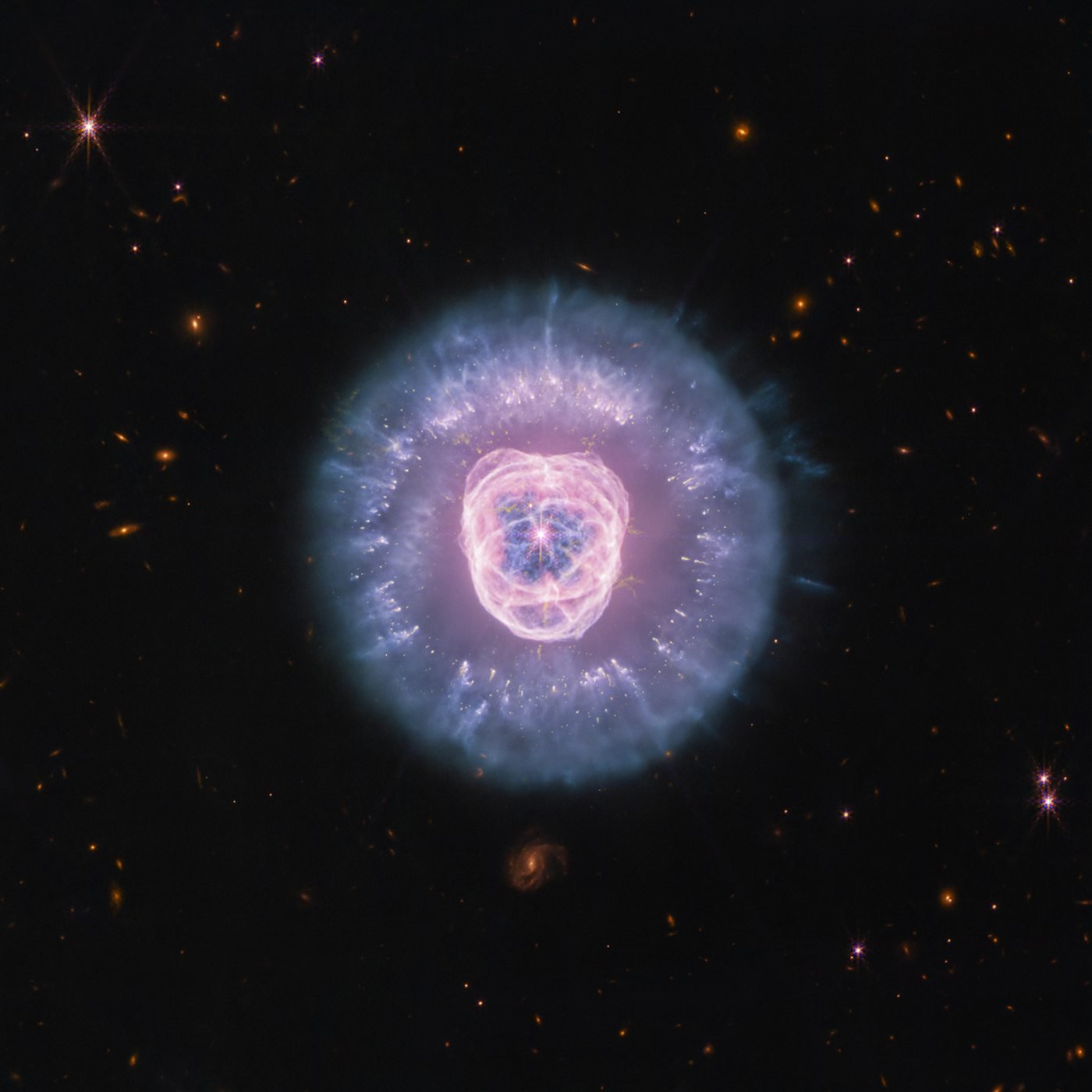
NGC 2392, the Lion Nebula, in combined NIRCam and MIRI infrared light. Credit: NASA, ESA, CSA, STScI; Image Processing: Alyssa Pagan (STScI)
NASA released a striking new image of NGC 2392 on August 10, 2026 — a planetary nebula nicknamed the Lion Nebula, and also catalogued as Caldwell 39, sitting roughly 5,000 light-years away in the constellation Gemini. The image combines data from two of the James Webb Space Telescope's instruments, NIRCam and MIRI, layering near- and mid-infrared light to reveal detail that wasn't visible in Hubble's original visible-light image of the same object, captured in 2000.
What's Actually in the Picture
At the center sits a white dwarf — the exposed, superheated core of a star that has shed its outer layers — appearing in the image as the "nose" of the lion. Around it, ionized gas forms bubbles and rings that make up the lion's "face," while an expanding dust shell, illuminated from within by the dying star, forms the distinctive "mane." Smaller, denser knots of dust — compact clumps that have so far survived the star's intense radiation — read as the lion's "hair tufts."
That layered structure is exactly what Webb's infrared instruments are suited to reveal. Dust and ionized gas that were faint or invisible in Hubble's optical view show up clearly in Webb's longer wavelengths, giving astronomers a much more complete picture of how the nebula is actually built.
A Star Still Reshaping Its Surroundings
The central white dwarf isn't a passive relic — its radiation and stellar wind continue to sculpt the surrounding material, carving and, in places, destroying the dust it once shed. Some of the denser clumps are withstanding that radiation for now, but not indefinitely: astronomers estimate the Lion Nebula will disperse completely within roughly 10,000 years, a brief span on astronomical timescales but far longer than any human observation of it.
Planetary nebulae like NGC 2392 are a preview of the Sun's own distant future — the same basic process, on a similar timescale, awaits stars of comparable mass.
Where to Find It
NGC 2392 sits in Gemini, making it a Northern Hemisphere-favorable target for visual observers and imagers with a small-to-medium telescope, though nowhere near the detail Webb's instruments reveal. For the deep infrared structure shown here, Webb's data — not backyard equipment — is what makes the difference.
Frequently Asked Questions
NGC 2392, nicknamed the Lion Nebula and also catalogued as Caldwell 39, is a planetary nebula in the constellation Gemini roughly 5,000 light-years away — a shell of gas and dust shed by a dying, Sun-like star.
The image combines data from Webb's NIRCam (Near-Infrared Camera) and MIRI (Mid-Infrared Instrument), layering near- and mid-infrared views to reveal structure not visible in earlier optical images.
Hubble imaged NGC 2392 in visible light in 2000. Webb's infrared instruments highlight dust clumps and ionized gas that were far less apparent in that earlier image, giving a clearer, more detailed view of the nebula's structure.