
Partial Lunar Eclipse of August 28, 2026: What Happened
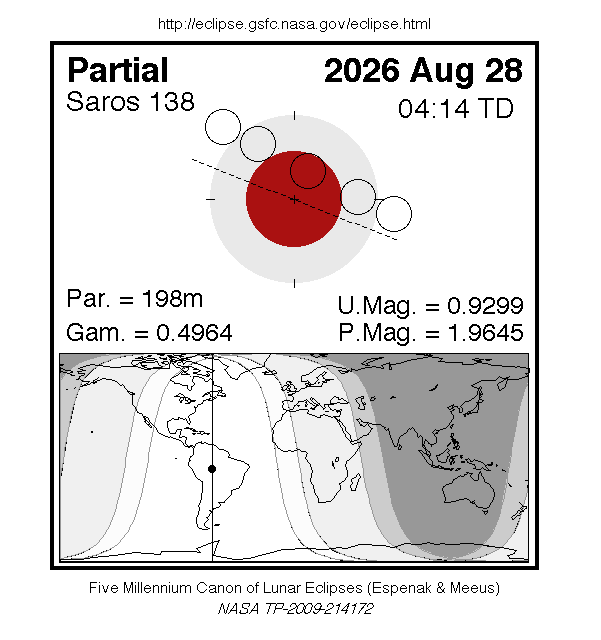
Global visibility map for the partial lunar eclipse of August 28, 2026. Credit: NASA/GSFC Eclipse Website (F. Espenak)
The final eclipse of August 2026 was a partial lunar eclipse on August 28 — one more major sky event before the month ended, and a far more forgiving one to watch than the total solar eclipse that had crossed Spain sixteen days earlier. As with every lunar eclipse, no special filters, glasses or precautions were needed: lunar eclipses are entirely safe to watch with the naked eye, binoculars or a telescope.
When It Happened
Per NASA's eclipse predictions, the partial phase began around 02:34 UT, greatest eclipse fell around 04:13 UT, and the partial phase ended around 05:52 UT on August 28, 2026. Lunar eclipse timing is orbital mechanics, not a forecast — these figures describe when the geometry occurred, not what any specific observer was able to see from the ground.
This eclipse belonged to Saros series 138. Its umbral magnitude was approximately 0.93 — meaning about 93% of the Moon's diameter passed into Earth's dark umbral shadow at maximum, a deep partial eclipse just short of total.
Geographic Visibility
By geometry alone, this eclipse was positioned to be visible, weather permitting, from locations where the Moon was above the horizon during the 02:34–05:52 UT window — broadly the Americas, Europe, Africa and western Asia, with exact local visibility depending on each location's moonrise and moonset times. ORIVON has not independently verified sky conditions or observation reports from any specific location, and doesn't claim any particular place had a clear view.
What the Eclipse Looked Like, By Geometry
For observers under clear skies within the visibility window, a dark bite would have appeared to grow across one side of the Moon's disc as it moved into Earth's shadow, deepening toward greatest eclipse before receding. Because the umbral magnitude was high without quite reaching totality, the eclipse would have shown a large, dark shadow crossing most of the Moon's face at maximum — without the fuller, reddish "Blood Moon" effect of a total lunar eclipse. ORIVON did not capture images of this event and is not claiming a specific observation from a specific location; this describes the expected visual effect of an eclipse with this geometry.
How a Lunar Eclipse Like This One Is Watched
No equipment is required for a partial lunar eclipse — it's a naked-eye event, always. Binoculars or a small telescope sharpen the view of the shadow's edge as it advances across lunar terrain, and it's a genuinely approachable target for astrophotography, needing nothing more exotic than a camera capable of manual exposure and a stable mount or tripod. These are general, evergreen facts about watching lunar eclipses, not a claim about how this specific one was actually observed.
For general eclipse-watching safety and technique, see ORIVON's eclipse safety guide.
Frequently Asked Questions
August 28, 2026. Per NASA's eclipse predictions, the partial phase began around 02:34 UT, greatest eclipse fell around 04:13 UT, and the partial phase ended around 05:52 UT — a calculated timeline, not a weather-dependent estimate.
No. Lunar eclipses are completely safe to watch with the naked eye, binoculars or a telescope — unlike a solar eclipse, there is no direct sunlight involved. This applies to every lunar eclipse, not just this one.
This eclipse had an umbral magnitude of about 0.93, meaning roughly 93% of the Moon's diameter passed into Earth's darkest shadow at maximum — a deep partial eclipse, though not quite total. That figure describes the eclipse's geometry, not what any specific observer actually saw, which depended on local sky conditions ORIVON has not verified.