
Cases & Field Kits: Protecting the Gear You Just Spent Money On
This article contains affiliate links. If you buy through them, ORIVON may earn a commission at no extra cost to you.
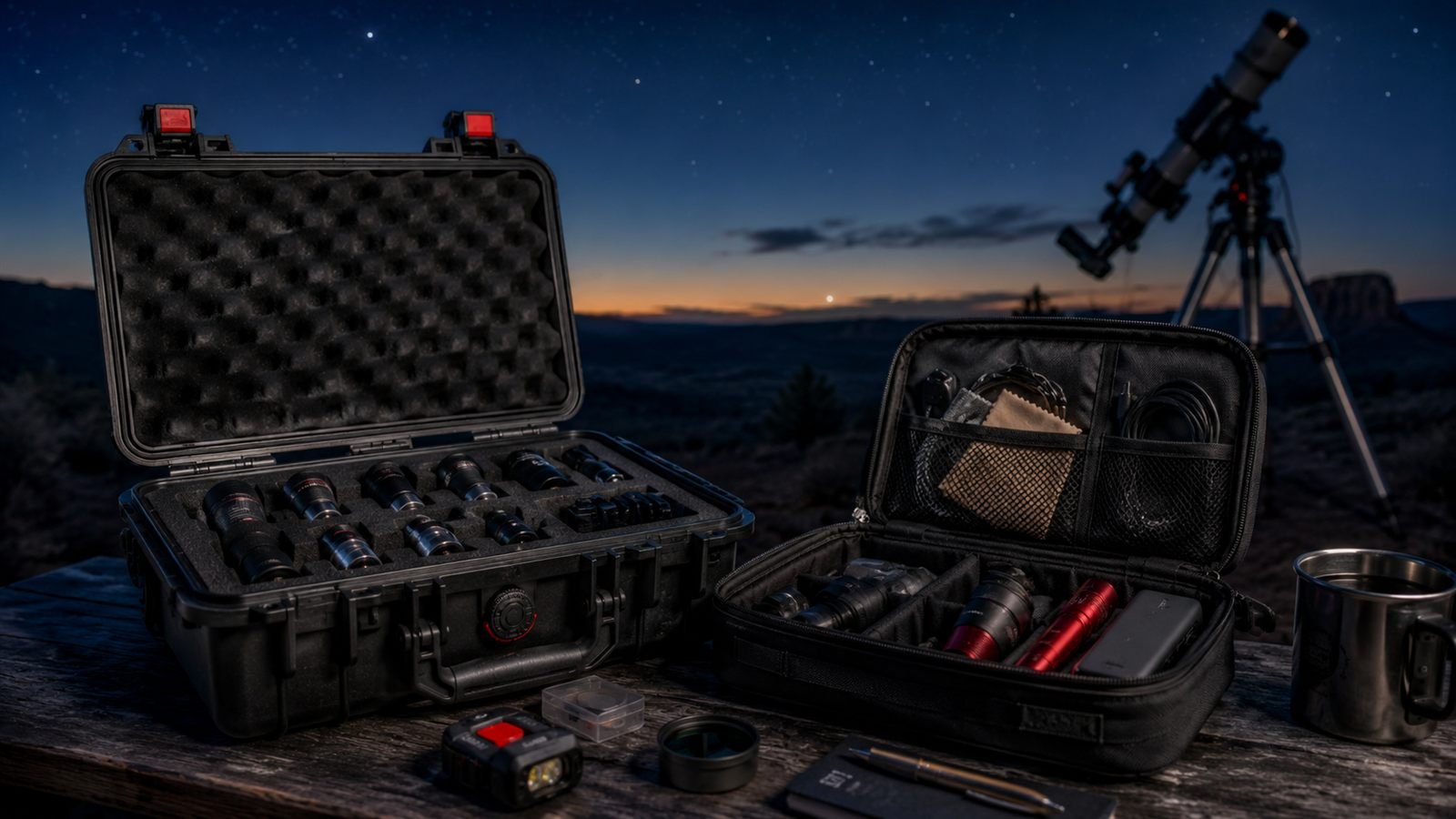
A hard case and a padded field kit, packed for a night session — protection against drops, dark-fumbling and dew.
Why a Dedicated Case Actually Earns Its Keep
A case is one of the least exciting purchases in this hobby, and one of the most consistently underrated. Eyepieces, filters and small mount hardware are precision optical and mechanical components — a single drop onto a concrete patio or driveway can knock an eyepiece out of collimation or crack a filter's coating, and there's rarely a warranty that covers "I set it down on the car and drove off."
The second problem a good case solves is less about damage and more about the dark itself. A field session happens with a headlamp on its dimmest red setting, if it's on at all, and loose eyepieces, dew shields and adapters in a backpack pocket are exactly how small parts get left behind on a lawn at 1 a.m. A case with a fixed slot for every piece means packing up by feel, not by search.
Humidity is the third, quieter reason. Dew is a normal part of a night under the stars, and gear that goes straight from a damp table into a sealed bag without protection is gear that develops fungus on internal glass surfaces over a few seasons. A case with a snug foam interior isn't waterproof, but it meaningfully slows how much moisture reaches the optics compared to a loose bag.
Astromania 1.25" Telescope Eyepiece Case
The Astromania case is a straightforward, purpose-built answer to all three problems above: a hard aluminum shell with a die-cut, shock-absorbing foam interior sized specifically for 1.25" eyepieces, Barlow lenses and filters.
| Shell Material | Aluminum, hard-sided |
| Interior | Die-cut, shock-absorbing foam |
| Compatibility | 1.25" eyepieces, Barlow lenses, filters |
| Closure | Latched lid with carry handle |
| Price | Approximately $30–$45 USD |
This assessment draws on manufacturer specifications and patterns in buyer feedback, which consistently point to the fitted foam layout as the case's main selling point over a generic padded bag.
What to Look For in a Field Case
Not every case needs to be this one specifically, but a few things are worth checking before buying any eyepiece or accessory case: a hard or semi-rigid shell rather than soft nylon, foam that's die-cut to your actual eyepiece sizes rather than generic pick-and-pluck cubes that shift over time, and a size that matches what you actually own rather than the largest case available "for later." An oversized case with rattling gaps defeats the point as thoroughly as no case at all.